Every Transitional Style Guide Tells You to Add a Layer. If You’re Already Covered, That’s the Wrong Advice.
Open any summer-to-fall guide published in the last three weeks and you will find the same instruction, phrased four different ways: add a cardigan. Add an overshirt. Throw a light blazer over it. Sling a sweater across your shoulders.
Every one of those assumes you started the day in a tank top.
If you dress modestly, you didn’t. You started at long sleeves, full-length hem and a scarf, in weather that is still comfortably above 30°C in most of the places reading this. The transitional problem you actually have is the exact inverse of the one those articles are solving. You don’t need more coverage. You need the coverage you already have to stop reading as July.
How do you transition a modest wardrobe from summer to fall?
By substitution, not addition. Change fabric, colour and footwear rather than adding layers — swap linen for lightweight suede or fine knit, move from bright neutrals to the season’s deeper palette, and replace sandals with closed shoes. Each swap signals autumn without adding a single degree of warmth.
That is the whole method. Everything below is how to run it.
The rule: one thing changes, nothing gets added
There are exactly four levers that make an outfit read as autumn: fabric, colour, footwear and silhouette. Layer count is not one of them — it is simply the lever that bare-arms dressers reach for first, because for them it is the cheapest.
For you it is the most expensive lever available. So use the other four, and use them one at a time. A single deliberate swap in a familiar outfit is more convincing than three hesitant ones, and it costs nothing in heat.
Start with whichever lever is easiest in your current wardrobe. Most readers will find it’s footwear.
Fabric does the heaviest lifting — and it doesn’t have to be heavy
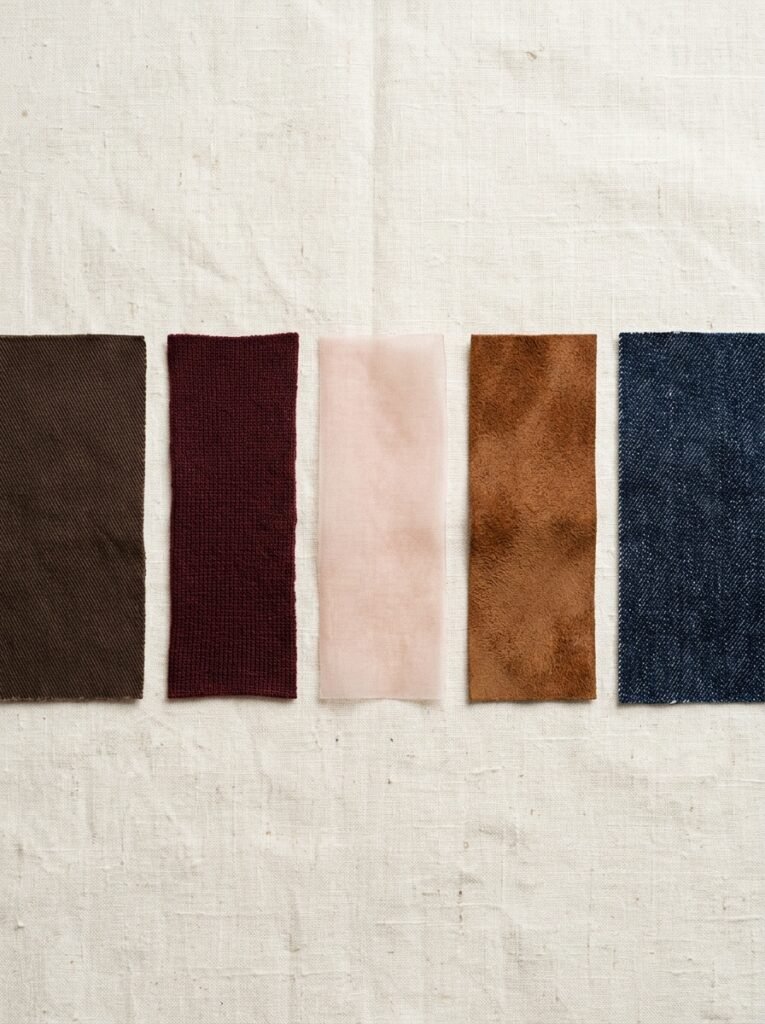
This is where most people get transitional dressing wrong in both directions. They assume “autumn fabric” means “warm fabric.” It doesn’t. It means fabric with a particular light behaviour: matte, textured, light-absorbing rather than light-reflecting.
Linen and crisp cotton poplin bounce light. They photograph as summer even in navy. Suede, fine-gauge knit, brushed cotton, crepe and washed twill absorb it. Same weight on your body, completely different season on your back.
Style editors have been pushing the same substitutions this month, and they work regardless of how covered you are. The Luxury Closet’s transitional guide points to corduroy, suede and knitwear as the textures that shift a look forward, and to lightweight wool, cashmere blends and structured cotton as the transitional-weight options that add depth without bulk. Urbanebox makes a sharper version of the same point: trade airy crochet for lightweight organza, and light-wash denim for a darker wash.
For a modest wardrobe, the practical translations are:
- Linen wide-leg trousers → washed twill or crepe wide-legs. Identical breathability, autumn surface.
- Cotton poplin shirt-dress → fine-gauge knit dress. Choose a merino or cotton-blend fine gauge, not a chunky one. It will feel lighter than you expect.
- Crochet or broderie overlay → organza or fine mesh overlay. Sheer, cool, and much more current.
- Light-wash denim skirt or barrel-leg jeans → indigo or near-black wash. The single cheapest fabric swap on this list, because you probably already own both.
- Cotton hijab → crepe, modal or a fine textured weave. More on scarves below.
Move your palette before you move your wardrobe
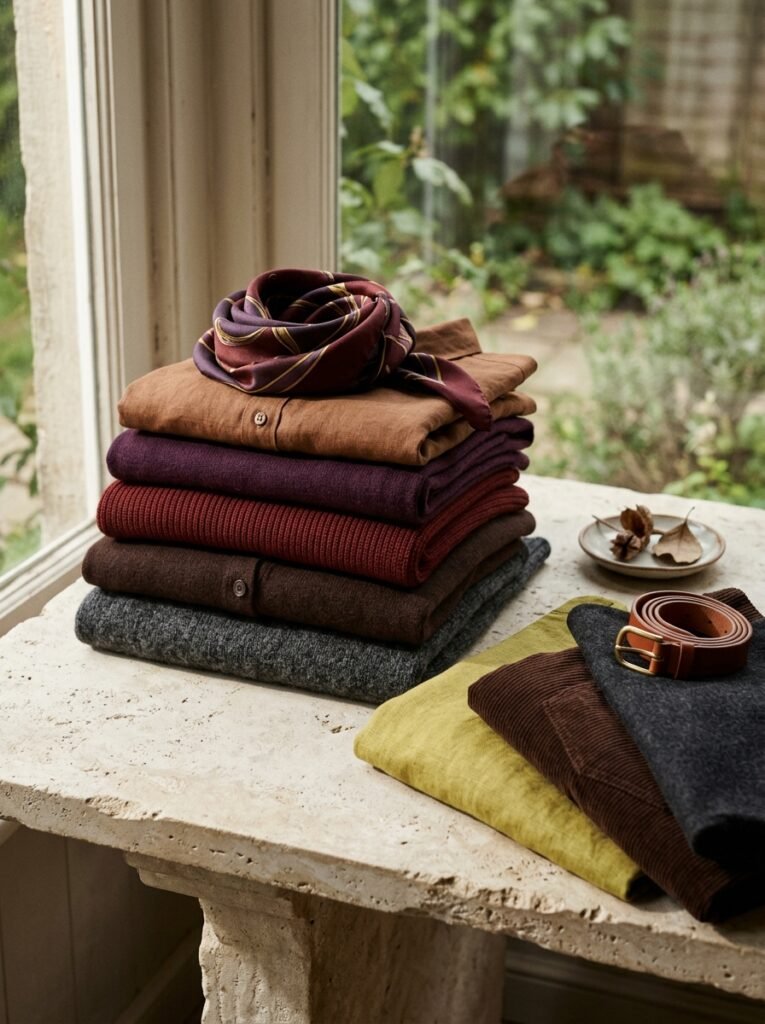
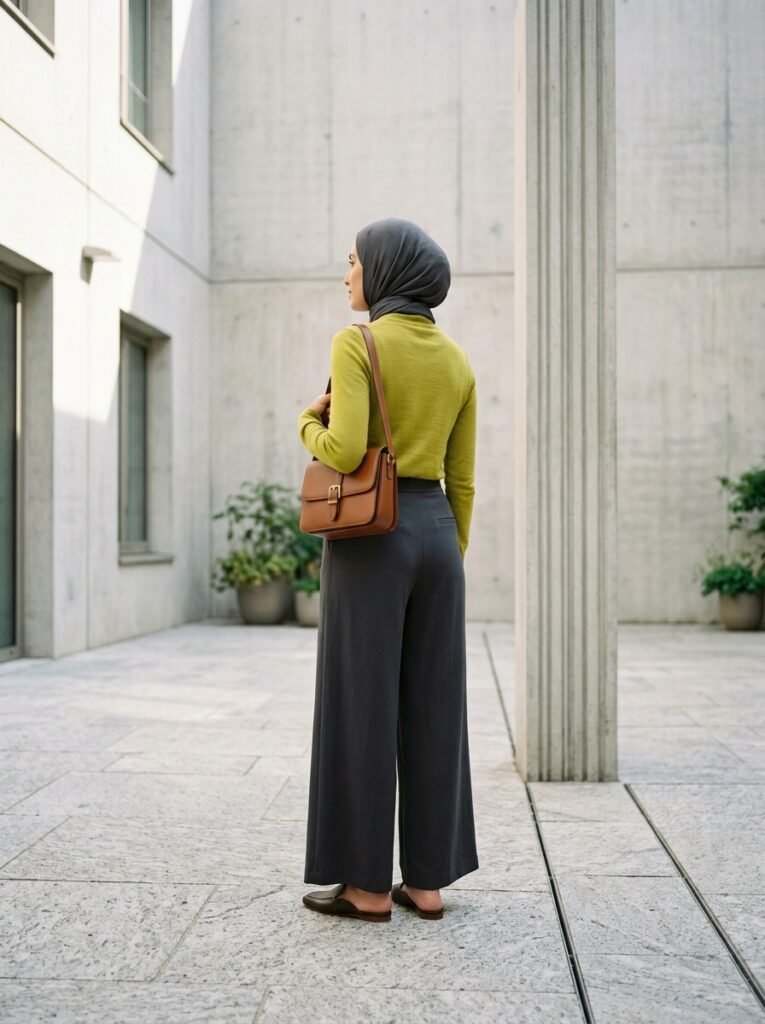
Colour is the fastest visual signal and the one Discover-era fashion coverage is loudest about. Fall 2026’s palette has settled around deep plum, oxblood and burgundy, warm chocolate and cognac browns, chartreuse as the sharp accent, and charcoal replacing black as the serious neutral.
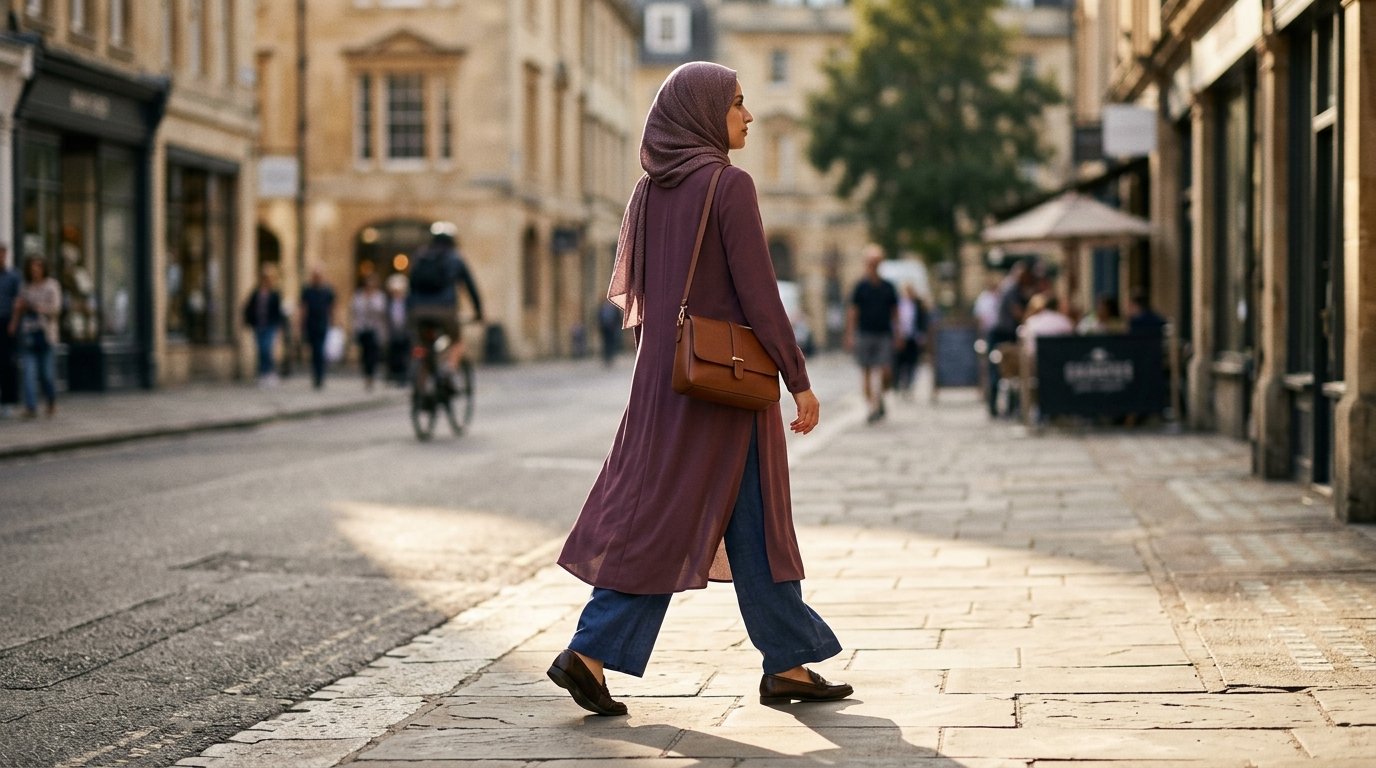
What’s new for the transitional weeks specifically is how much colour you use at once. The Luxury Closet notes that colour blocking is back for fall 2026 but in a more restrained form — large, clean fields of contrasting colour rather than the busy patchwork of previous cycles. That restraint is a gift to modest dressing, because a long silhouette is already a large field of colour. A plum abaya against a cognac bag and charcoal shoes is the trend, executed correctly, with no extra effort.
A caution worth stating plainly: you do not need to buy the palette. Introducing one deep shade into an outfit you already own — a scarf, a bag, one trouser — moves it further than replacing everything. Full-season colour overhauls are how people end up with a wardrobe that works for eight weeks a year.
Change your shoes first — it’s the fastest lever you have
If you only do one thing this week, do this one. Footwear is the highest-impact, lowest-cost transitional move available, and it is the one every guide in this space agrees on.
The mechanism is simple: an open toe reads summer no matter what is above it. A closed one reads autumn no matter what is above it. Sandals to loafers, ballet flats or a low boot changes the season of an entire outfit in under a minute.
For fall 2026 specifically, the runways pointed in a few clear directions. Who What Wear’s read on the fall/winter shows found animal-print footwear returning with genuine freshness at Jil Sander, Khaite and Saint Laurent, and a sharp stiletto boot silhouette running through Tom Ford, Khaite and Schiaparelli. Boot-shape reporting has also flagged a shift away from the chunky block heel toward the kitten heel as the new default, plus fur-trimmed and over-the-knee shapes at Duha, Casadei, Paris Texas and Gianvito Rossi.
Translate that for August rather than October:
- Now: loafers, mesh or leather flats, a low closed-toe mule, a sleek sneaker in a deep neutral.
- In a few weeks: an ankle boot in suede, a kitten-heel boot, a pointed flat.
- Save for actual cold: over-the-knee, fur trim, anything shearling-lined.
With a maxi or abaya, the shoe barely shows — which is exactly why it is a low-risk place to experiment with a print or a heel shape you have not tried.
Substitute a layer, don’t stack one
Sometimes you genuinely do want a second piece — for structure, for shape, for the visual weight that makes an outfit look composed. The rule is that it replaces something rather than sitting on top of it.
Who What Wear’s August read named three transitional shapes that fashion editors are wearing right now: tunics over denim, shrugs with tanks and trousers, and silk blouses with Bermuda shorts. Two of the three adapt cleanly to a modest wardrobe if you treat them as substitutions.
Tunic over trousers is already a modest staple — the update is proportion. A longline tunic in crepe or fine knit over a straight or barrel-leg trouser, in two shades of the same colour family, is a fall 2026 silhouette rather than a default one.
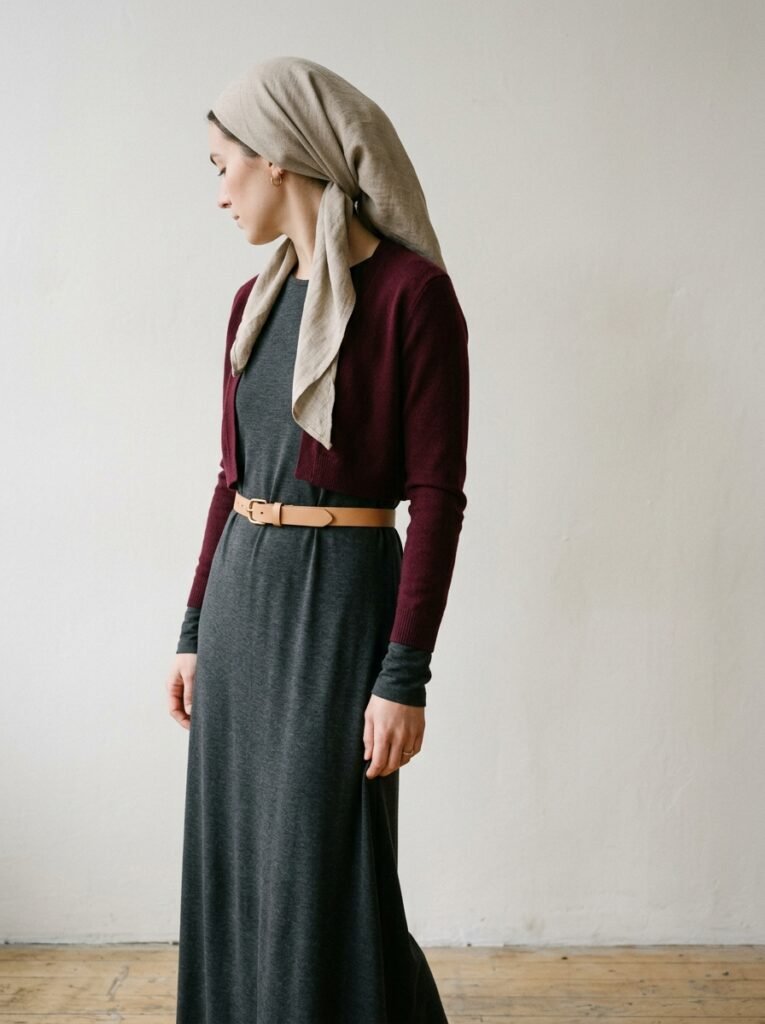
The shrug is the single most useful transitional piece for covered dressing that nobody is telling you about. A cropped fine-knit shrug or bolero over a long-sleeved dress adds structure at the shoulder — the visual signal of a jacket — with a fraction of the fabric. It reads as a layer. It doesn’t behave like one.
The open longline waistcoat does the same job in the other direction: vertical line, no sleeves, no heat.
What to skip until the temperature actually drops: the denim jacket over an already long-sleeved dress, the blazer over a full abaya, the trench over anything. These are addition, not substitution, and in August they are simply uncomfortable.
Eight modest transitional formulas to copy
Each of these is a substitution, not an addition. None of them will make you hotter than what you are wearing now.
1. Deep denim + longline tunic. Indigo or near-black barrel-leg jeans, crepe tunic in chocolate or plum, loafers, structured bag. The most repeatable outfit on this list.
2. Fine-knit column dress. A single fine-gauge knit maxi in oxblood or charcoal, thin belt at the natural waist, pointed flats. No second piece required.
3. Two-tone colour block. Chartreuse top half, charcoal bottom half, or plum against cognac. Two clean fields, nothing else competing.
4. Suede accent, cotton base. Keep the outfit in the lightweight cottons you’re already wearing, then add suede in one place only — bag, shoe or belt. Cheapest possible seasonal signal.
5. Shrug over a summer maxi. The dress you have worn all July, plus a cropped fine-knit shrug in a deeper shade. Same dress, different season.
6. Organza overlay. A sheer organza kimono or overshirt over a matching-tone base. Coverage, movement, near-zero warmth.
7. Washed twill wide-legs + silk blouse. Fluid, matte, dressy enough for work. Add a lightweight scarf in a contrasting deep tone.
8. Monochrome abaya, autumn-weight accessories. Black or charcoal abaya, cognac leather bag, closed-toe shoe, one metallic piece. The ’80s-leaning shine running through the fall shows — gold lamé at Gucci, Ferragamo and Mugler — arrives here as a single gold detail, not a fabric.
About the scarf, in the heat
Worth saying, since it is the piece that most affects comfort and the one generic guides never mention.
Transitional-weight scarf fabrics behave differently from summer cottons. Crepe, modal and fine textured weaves sit closer to the head, drape more sharply, and read as autumn where a light cotton reads as summer — while still breathing far better than jersey. Jersey and heavier viscose are genuinely warm, and are worth holding back until the mornings are cool.
Colour applies here too, and it is the cheapest way into the season’s palette: a plum, oxblood or chocolate scarf against a neutral outfit shifts the whole look forward for the price of one piece.
What to leave alone until it’s actually cold
The trends dominating fall 2026 coverage are not all wearable in August, and pretending otherwise is how transitional dressing goes wrong.
Chainmail and “modern armor.” One of the strongest fall/winter 2026 runway stories — chainmail detailing appeared at Ralph Lauren, Celine and Alexander McQueen. It is also metal against skin in summer heat. Hold it.
Statement outerwear. The season’s coats are the most exciting part of the fall story and the least useful part of August. They will still be there in six weeks.
Fur trim, shearling, heavy suede. All present in the fall boot reporting, all wrong for now.
Full head-to-toe trend adoption. The point of a transitional wardrobe is that it works for about six weeks. Anything you buy specifically for that window should also work in October.
Key takeaways
- The standard transitional playbook assumes bare arms. If you’re already covered, invert it: substitute, don’t add.
- Four levers move an outfit into autumn — fabric, colour, footwear, silhouette. Layer count isn’t one of them.
- Autumn fabric means matte, not warm. Suede, fine knit, crepe, washed twill and organza all read as fall at summer weight.
- Shoes are the fastest change you can make. Closed toe, deep neutral, done in a minute.
- Shrugs and longline waistcoats give you the look of a layer without the behaviour of one.
- One deep colour is enough. A scarf or bag in plum, oxblood or cognac shifts an entire outfit.
- Leave chainmail, statement coats and fur trim until the weather earns them.
FAQ
Q1. How do you transition a modest wardrobe from summer to fall without overheating?
By substituting rather than adding. Change the fabric of pieces you already wear — linen to washed twill, poplin to fine-gauge knit, crochet to organza — move your palette toward the season’s deeper shades, and switch from open-toe to closed-toe shoes. Each of these signals autumn at the same body temperature.
Q2. What are the fall 2026 colours for modest outfits?
Deep plum and purple, oxblood and burgundy, chocolate and cognac browns, chartreuse as an accent, and charcoal in place of black as the serious neutral. Colour blocking has returned for the season in a restrained form — large clean fields of contrasting colour rather than busy patchwork, which suits long modest silhouettes naturally.
Q3. What shoes work best for transitional modest outfits?
Anything closed-toe. Loafers, pointed flats, mesh or leather flats, low closed mules and sleek deep-neutral sneakers all work in August heat. Ankle boots and the kitten-heel boot shapes trending for fall 2026 come in a few weeks later; over-the-knee and fur-trimmed styles are for genuine cold.