MICRONEEDLING VS RF MICRONEEDLING: COST, DOWNTIME AND RESULT
Walk into three clinics in three different cities and ask for both treatments, and one number will keep repeating itself: the radiofrequency version costs roughly three to four times more per visit than the plain one. Same needles. Similar appointment length. A name that differs by two letters. That multiple is the first thing worth understanding about microneedling vs RF microneedling, because it is not arbitrary — it maps almost exactly onto how deep into your skin each treatment is capable of working, and how much can go wrong if it is done badly.
QUICK ANSWER
Microneedling vs RF microneedling is a question of depth and energy. Plain microneedling injures the skin mechanically with fine needles and works mainly near the surface. RF microneedling releases heat from those needles into the deeper skin, which allows real tightening — at a higher price, with longer recovery and a much greater dependence on operator skill.
KEY TAKEAWAYS CHECKLIST
☐ Plain microneedling handles surface concerns: texture, tone, pore appearance, fine lines.
☐ RF microneedling handles structural concerns: laxity, sagging along the jaw and neck, deep pitted scars.
☐ Expect roughly a threefold to fourfold price gap per session in most markets worldwide.
☐ Expect roughly one to two days of visible recovery from plain, and three to five from RF.
☐ Neither works overnight — the collagen response takes weeks to show, and months to peak.
☐ The single biggest variable in your outcome is not the machine. It is the person holding it.
MICRONEEDLING VS RF MICRONEEDLING AT A GLANCE
| Criterion | Plain microneedling | RF microneedling |
|---|---|---|
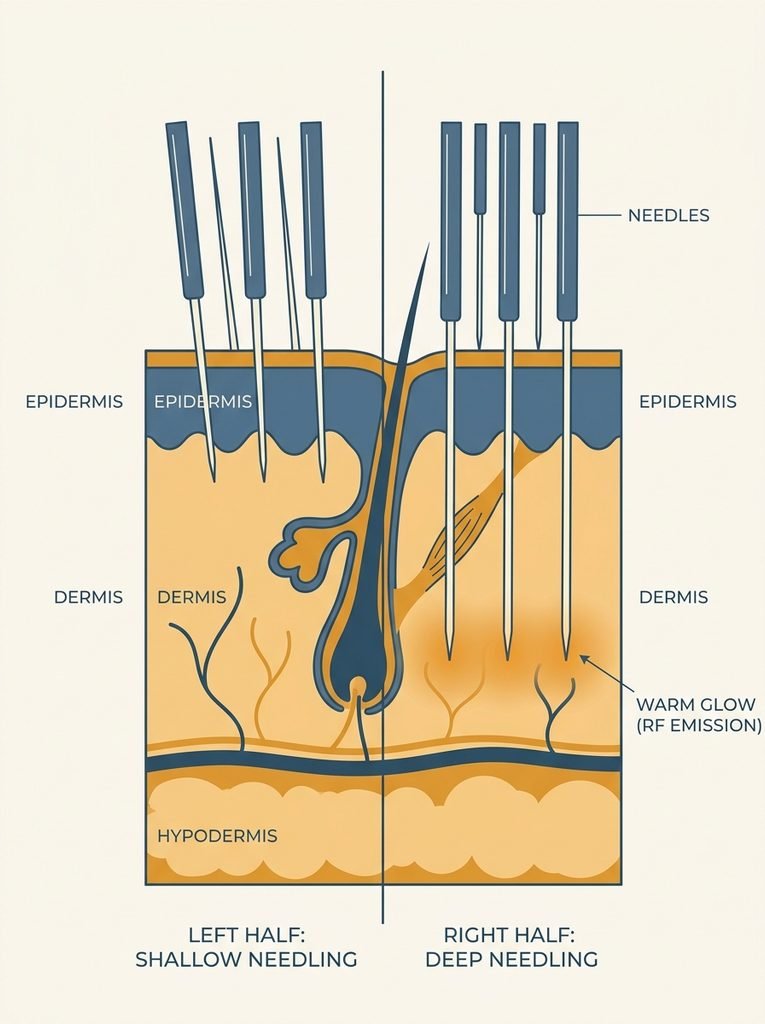
| What creates the effect | Physical puncture only | Physical puncture plus heat released in the dermis |
| Working depth | Mostly upper skin layers | Mid to deep dermis, adjustable by device |
| Relative price per session | Baseline (1×) | Typically 3–4× the baseline |
| Sessions usually planned | 3–6 | 2–4 |
| Visible recovery | About 1–2 days | About 3–5 days |
| Strongest use case | Texture, tone, early lines, shallow scarring | Laxity, contour, deep atrophic scars |
| Discomfort level | Manageable with numbing cream | Higher — the heat pulse is felt |
| Skill dependency | Moderate | High, and unforgiving of error |
| Equipment cost to the clinic | Low — a handheld pen | High — a console system with consumable tips |
| Insurance coverage | Cosmetic, so almost never covered | Cosmetic, so almost never covered |
HOW THE TWO TREATMENTS ACTUALLY DIFFER
Plain microneedling often listed on menus as collagen induction therapy — relies on one idea: the skin repairs itself better than it maintains itself. A cartridge of very fine needles moves across the treatment area, opening thousands of temporary channels. Each channel is a small, deliberate wound. The skin responds the way skin always responds to injury, by recruiting repair cells and depositing fresh collagen and elastin as the channels close.
Nothing else is added. The stimulus is entirely mechanical, which means its reach is limited by two things: how long the needles are, and how steadily the practitioner controls them across curved, uneven facial anatomy. Push a mechanical needle deeper and you increase trauma without gaining much extra remodelling. That ceiling is exactly why the second technology exists.
RF microneedling keeps the needles but turns them into conductors. Once the tips are seated at the chosen depth, the device discharges radiofrequency energy from them into the surrounding tissue. The tissue resists that current, resistance produces heat, and heat does two things at once. Existing collagen fibres contract immediately, which is why some patients notice a subtle firming within days. More importantly, the heated zone becomes a site of controlled thermal injury, and the repair response that follows produces new collagen over the following months.
The elegant part is what the heat does not touch. Because the energy is released from the needle tips rather than across the skin surface, most of the thermal work happens below the outer layer while the surface is comparatively spared. That separation is what keeps recovery reasonable despite the treatment reaching far deeper than any mechanical device can.
Different manufacturers use different needle designs. Some insulate the upper part of the needle so energy is released only at the tip; others leave the shaft uncoated so heat spreads along its full length. Neither approach is universally better, but the distinction matters for pigment-prone skin, which the article returns to later.

WHAT DRIVES THE GAP, AND HOW TO COMPARE IT PROPERLY
Publishing one price table would be useless to a global reader, because aesthetic pricing tracks local wages, rent and regulation far more than it tracks the treatment itself. A session that costs the equivalent of a week’s salary in one country can cost a day’s wages in another. What travels across borders is the ratio and the structure.
The ratio. Almost everywhere, plain microneedling sits at the low end of a clinic’s energy-device menu and RF microneedling sits near the top. Budget the RF version at roughly three to four times the plain version in the same clinic. If a clinic quotes you RF at barely more than plain microneedling, ask why — either they are running an introductory offer, or the device is operating at settings so conservative that you are paying for a mechanical treatment with a marketing surcharge.
The structure. Four things move the number in every market:
| Cost driver | Effect on price |
|---|---|
| Treatment area | Face only is cheapest; face plus neck adds meaningfully; body areas cost most |
| Session count | Plain needs more sessions at a lower unit price; RF needs fewer at a higher one |
| Practitioner | Physician-led clinics charge above nurse-led ones; both above beauty-therapy settings |
| Consumables | RF needle cartridges are single-use and expensive, and that cost is built into your quote |
| Add-ons | Growth-factor serums, PRP, exosome preparations and LED all sit on top of the base price |
Compare courses, not sessions. This is where most people miscalculate. Plain microneedling is usually planned as a series of four or so treatments spaced roughly a month apart, then maintained once or twice a year. RF is usually planned as two to four treatments on similar spacing, with maintenance stretched further out because the remodelling runs deeper.
Multiply it through and the gap narrows considerably. If plain sits at one unit per session across four sessions, that is four units. If RF sits at three and a half units across three sessions, that is around ten and a half. RF remains meaningfully more expensive, but roughly two and a half times over a full course rather than the four times the single-session sticker implies.
DOWNTIME, DAY BY DAY
Clinics love calling these lunch-hour treatments. That is true of one of them and optimistic about the other.
PLAIN MICRONEEDLING
| Timeline | What to expect |
|---|---|
| First few hours | Warmth, tightness, redness comparable to sun exposure |
| Day 1 | Redness settling; skin feels dry and slightly taut |
| Day 2 | Most people look normal; light makeup usually acceptable |
| Days 3–5 | Occasional fine flaking as the surface turns over |
RF MICRONEEDLING
| Timeline | What to expect |
|---|---|
| First few hours | Marked redness, heat, and a faint grid of pinpoint marks where the tips entered |
| Day 1 | Swelling often at its most noticeable, particularly around the eyes and cheeks |
| Days 2–3 | Swelling easing; the grid pattern still visible under good light |
| Days 4–5 | Surface roughness or a sandpaper texture as micro-crusts shed |
| Week 2 onward | Skin looks normal; the internal remodelling continues invisibly |
Two practical points. First, RF downtime scales with the settings used, so the same device can produce a two-day recovery or a five-day one depending on depth, energy and number of passes. Ask what the plan is before you book around it. Second, avoid scheduling either treatment inside the two weeks before an event you will be photographed at. The risk is not that something goes wrong — it is that ordinary, entirely normal healing does not photograph well.
Common to both: sun protection stops being optional. Freshly treated skin responds to ultraviolet exposure by producing pigment unpredictably, and that is the most frequent way a good result gets undermined by the patient rather than the practitioner.
WHAT TO EXPECT, AND WHAT NOT TO
The most useful thing to understand about results is the timeline, because it manages the disappointment that hits around week two.
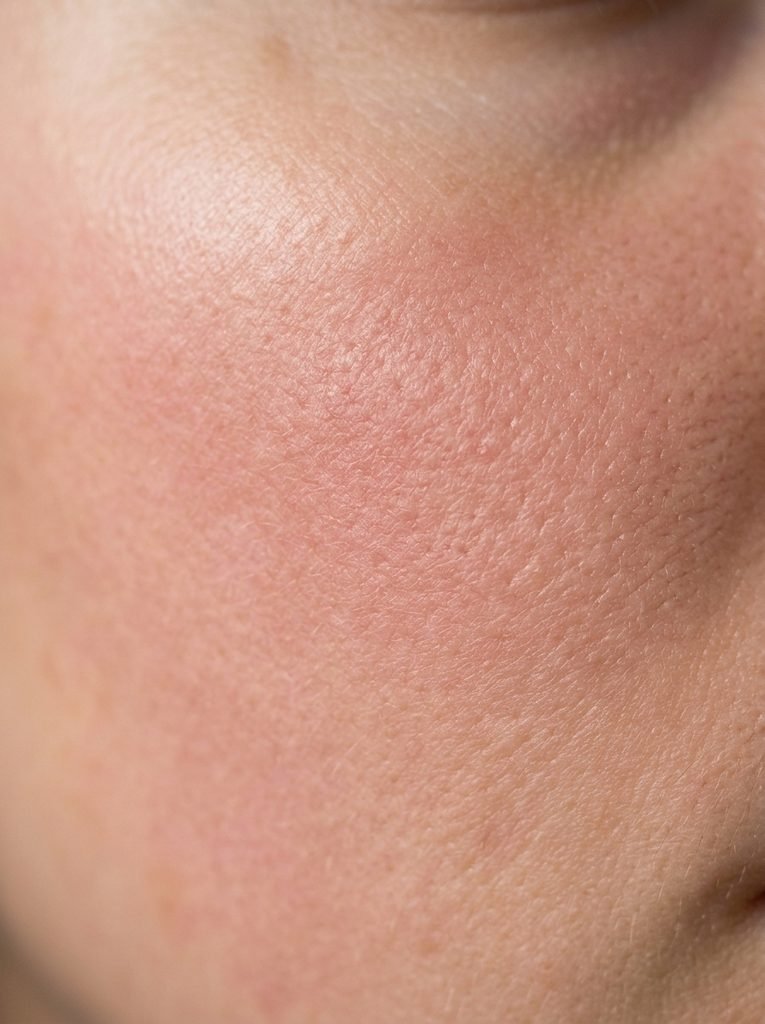
Both treatments work by triggering a repair process, not by removing anything. Nothing is resurfaced away and nothing is filled in. Your body builds the improvement, on its own schedule. Expect a brief plumped look from swelling in the first days, a flat and unremarkable stretch after that, then a gradual improvement that becomes noticeable somewhere around six to eight weeks and continues developing for around three months after the final session. Judging either treatment before the twelve-week mark is judging it early.
FOR TEXTURE, TONE AND PORE APPEARANCE. Plain microneedling performs well here and is arguably the better value. These are surface concerns and the treatment works at the surface. Paying a premium for radiofrequency to address them is spending on depth you have no use for.
FOR FINE LINES. Both help. Neither erases. Fine lines respond to improved collagen density, and both treatments increase it, RF somewhat more assertively. Deep static folds are a different problem and neither treatment is the right tool for them.
FOR SKIN LAXITY. This is RF’s genuine territory and there is no real contest. Mechanical needling cannot meaningfully tighten a jawline or a submental area because it never reaches the tissue that would need to change. Heat can. If sagging is your primary concern, plain microneedling will not deliver, no matter how many sessions you buy.
FOR ACNE SCARRING. Depth of the scar decides. Shallow, rolling irregularities often respond acceptably to plain microneedling. Deep, sharply defined pitted scars are anchored by fibrous tethers well below the surface, and treating them requires something that can reach and remodel that tissue — which is where RF, sometimes combined with other approaches, earns its price.
Two honest caveats worth reading twice.
Firstly, results are not permanent. You are stimulating collagen production, not stopping the ageing that reduces it. Skin continues changing after the course ends, which is why maintenance is part of every legitimate treatment plan rather than an upsell.
Secondly, published research comparing these treatments against each other and against other modalities tends to show smaller differences than clinic marketing implies. Several energy-based approaches produce broadly comparable improvement in scarring, and combining technologies does not reliably outperform doing one of them properly. Radiofrequency microneedling is genuinely effective. It is not a different category of outcome, and anyone presenting it as one is selling rather than advising.

THE SAFETY DIFFERENCE MOST COMPARISONS SKIP
This section deserves your attention more than the price table did.
Plain microneedling’s risk profile is modest and mostly self-limiting. Redness, temporary sensitivity, occasional flaking, and — the main real risk — infection or irritation if hygiene or aftercare is poor. Serious lasting harm is uncommon, largely because there is a natural ceiling on how much damage a fine needle can do at shallow depth.
Radiofrequency changes that equation, because heat delivered at the wrong depth or the wrong intensity does not stay contained. Regulators in several markets, including the United States, have publicly flagged reports of significant complications from radiofrequency microneedling devices — burns, scarring, changes in facial contour from loss of fat beneath the skin, altered sensation from nerve irritation, and lasting pigment change. These reports are uncommon relative to how many treatments are performed, and professional dermatology bodies have responded by reaffirming that the technology is safe in trained hands. Both statements are true at once, and the reconciliation is the point.
Look at what the reported problems have in common. They cluster around excessive depth, excessive energy, treatment of thin or anatomically risky areas such as around the eyes, and operators who have not been trained in facial anatomy. That is not a technology failure. It is a training failure with a technology capable of expressing it.
The practical conclusion is straightforward. With plain microneedling, a mediocre practitioner mostly wastes your money. With RF microneedling, a mediocre practitioner can cause harm that outlasts the money. Shop accordingly.
✔ DO / ✘ DON’T BEFORE BOOKING RF
| ✔ Do | ✘ Don’t |
|---|---|
| Ask what the operator’s medical qualification is, and what training they hold on that specific device | Assume that a clinical-looking room implies clinical training |
| Ask which depths and energy levels they plan to use, and why, for your face | Accept an identical protocol applied to every patient who walks in |
| Ask to see their own before-and-after photographs of patients with your skin tone | Judge a clinic on manufacturer marketing images |
| Ask directly what happens, and who manages it, if a complication develops | Book from a limited-time social media offer without consultation |
| Request conservative settings for your first session and review the response | Ask for maximum intensity because you want faster results |
| Discuss the eye area separately and specifically | Assume delicate zones are treated the same way as cheeks |

SKIN TONE CHANGES THE CALCULATION
For readers with richly pigmented skin — a large share of a worldwide audience — this is a decision factor, not a footnote.
The relevant risk is post-inflammatory hyperpigmentation: melanin-producing cells responding to injury or inflammation by depositing extra pigment, leaving patches that can take months to fade. Deeply pigmented skin is more reactive in this way, which historically made many practitioners cautious about energy devices in these patients.
Radiofrequency has a structural advantage worth understanding. Lasers work by being absorbed by a target, and in darker skin, surface pigment competes for that energy, which is what drives the risk. Radiofrequency does not work through absorption by pigment at all — it heats tissue by electrical resistance, and it does so beneath the surface. That makes its behaviour more predictable across the full range of skin tones than pigment-targeting technologies.
That advantage is conditional, not automatic. Heat still produces inflammation, and inflammation is the trigger. Needle insulation matters here: devices that release energy only at the tip keep heat away from the pigment-rich upper layer, while uninsulated designs spread it along the shaft. Settings matter more. And technique matters most.
Sensible practice for anyone with pigment-prone skin:
☐ Choose a practitioner who treats your skin tone routinely, and ask to see their results on patients like you
☐ Discuss a pigment-calming topical regimen in the weeks before treatment
☐ Begin conservatively and let the first session inform the second, rather than committing to a package upfront
☐ Avoid treatment on recently tanned or sun-exposed skin, when pigment cells are already active
☐ Treat daily broad-spectrum sun protection afterwards as part of the treatment, not an accessory to it
WHICH SHOULD YOU CHOOSE
CHOOSE PLAIN MICRONEEDLING IF:
☐ Your concerns are texture, dullness, pore appearance or early fine lines
☐ Your scarring is shallow and rolling rather than deep and pitted
☐ Your skin is still firm and laxity is not part of the picture
☐ You want the lower-risk introduction to treatments of this kind
☐ Your budget suits a longer series of smaller payments
☐ You would rather test how your skin behaves before committing to anything stronger
CHOOSE RF MICRONEEDLING IF:
☐ Laxity is your main complaint — jawline, jowls, neck or under-eye area
☐ You have deep, sharply defined pitted scarring
☐ You have completed a plain microneedling course and want more than it delivered
☐ You can budget for a shorter series of significantly larger payments
☐ You can absorb three to five days of visible recovery per session
☐ You have found a properly trained, medically qualified operator experienced on that device
WAIT, AND DO NEITHER FOR NOW, IF:
☐ You are pregnant or breastfeeding
☐ You have active acne, an active infection, or an inflammatory skin flare
☐ Your skin is currently tanned or recently sunburnt
☐ You have a keloid tendency, a relevant autoimmune condition, or metal implants near the area
☐ You are taking medication that affects skin healing — raise it before booking, not after
☐ The only practitioner available cannot answer the questions listed above with confidence
ACTION PLAN BEFORE YOU BOOK
☐ Photograph your face first. Flat daylight, no makeup, three angles, same spot each time. Memory is a poor judge of gradual change.
☐ Name one primary concern. Laxity points to RF. Texture points to plain. Attempting to solve everything simultaneously is how budgets get wasted.
☐ Consult at two clinics, and ideally include one that owns both technologies. A clinic with a single device can only ever recommend that device.
☐ Ask the training question out loud. Who performs it, what is their qualification, how many have they done, on this machine.
☐ Price the full course including consumables and any add-ons, and ask what a package costs against paying per session.
☐ Protect the calendar. One to two clear days for plain, three to five for RF, before anything that matters socially or professionally.
☐ Get aftercare in writing, and follow your practitioner’s instructions over anything you read online, including this article.
☐ Diarise a review at twelve weeks and re-shoot the same photographs in the same light before deciding whether it worked.
FAQ
IS RF MICRONEEDLING WORTH THE HIGHER PRICE?
It depends entirely on what you are treating. For laxity and deep pitted scarring, the extra cost buys access to tissue that plain microneedling cannot reach, and the difference in outcome is real. For texture, tone and fine lines, you are paying a premium for depth you will not use. Match the tool to the problem rather than assuming the expensive option is the better one.
HOW MANY SESSIONS WILL I NEED?
Plain microneedling is typically planned as three to six treatments about a month apart, with periodic maintenance afterwards. RF microneedling is usually planned as two to four. The exact number should be set by a practitioner who has examined your skin, not quoted over the phone before anyone has seen it.
CAN THESE TREATMENTS BE USED ON THE BODY?
Yes. The neck, chest, abdomen, arms and thighs are all treated, with cost scaling to the size of the area. Thinner-skinned regions such as the neck deserve more caution and more conservative settings than the face, because there is less tissue between the needle tip and the structures underneath.