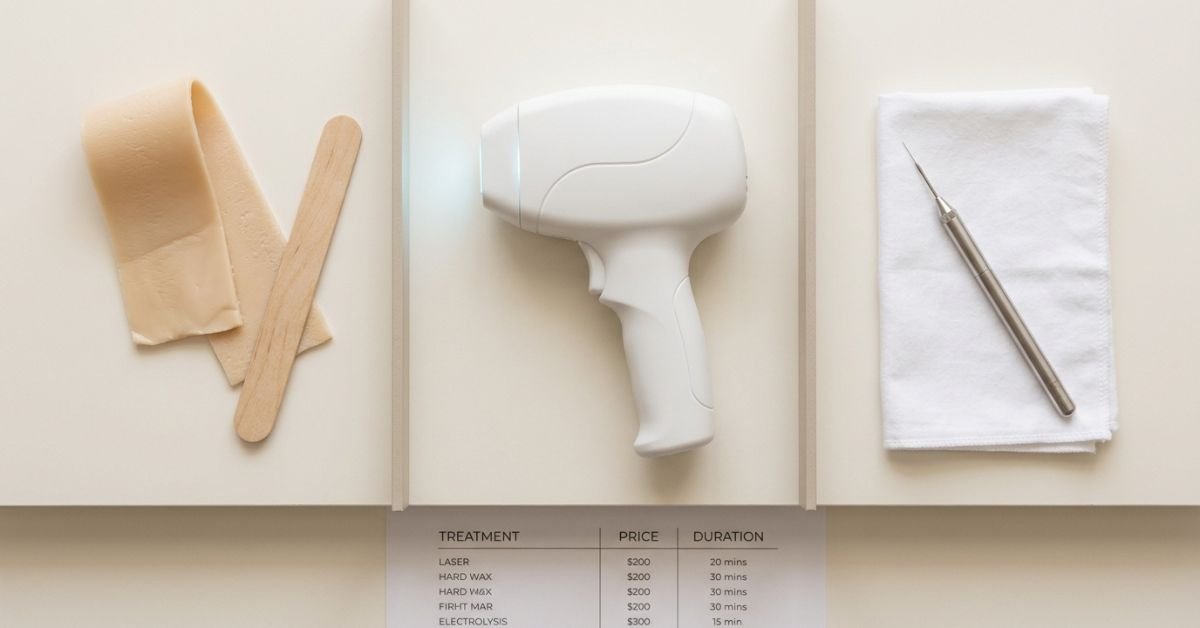
Laser vs Waxing vs Electrolysis Cost: The Real 5-Year Comparison
Here is the error almost everybody makes, and it happens before the consultation even begins. You look up the price of one wax appointment, look up the price of one laser session, notice the second number is bigger, and conclude that waxing is the cheaper option. Then you book the wax.
That comparison is broken at the root. Waxing has no finish line. Laser and electrolysis do. Setting a recurring expense against a one-off one on a per-visit basis will always flatter the recurring expense, in the same way that a monthly bus fare will always look cheaper than a bicycle until you count the months.
Five years is the fair window. It is long enough for a laser course to complete and begin needing upkeep, long enough for electrolysis to clear a modest area, and long enough for waxing to reveal what it truly costs when nothing about the follicle has changed at all.
Quick answer: Across five years, laser hair removal is usually the cheapest of the three for every commonly treated area though on large zones like full legs its lead is slim. Laser overtakes waxing at roughly month 29. Electrolysis, the most expensive on this horizon, does not break even against waxing until around year eight.
What does each method actually charge you for
The three methods are not just priced differently they are priced on three incompatible logics, which is precisely why comparing them is so easy to get wrong.
Waxing sells you an outcome that expires. You pay for an appointment, you leave smooth, and the follicle entirely undamaged begins growing again on schedule. The price never falls and the cycle never ends.
Laser sells you a course, not a session. The individual session price is close to meaningless, because a single treatment achieves very little on its own. Hair grows in staggered cycles, and each pass only affects the follicles that happen to be in an active growth phase, which is why a meaningful result takes six to eight sittings spread across most of a year. Clinics know this, which is why almost all of them discount heavily for the package. Paying visit by visit is the most expensive way to buy laser.
Electrolysis sells you time. The electrologist treats one follicle at a time with a fine probe, so your invoice is determined by hair density rather than by which body part you are treating. Two clients booking the identical service can end up with totals that differ threefold.
| Method | What you are buying | Typical cost in units (U) | Payment rhythm |
|---|---|---|---|
| Waxing | An appointment | Bikini 1.0 U · underarms 0.4 U · lip and chin 0.4 U · full legs 1.3 U | Every 3–6 weeks, indefinitely |
| Laser | A course of 6–8 sessions | Underarms ~10 U · lip and chin ~10 U · bikini ~20 U · full legs ~35 U | One course over 8–12 months, then occasional top-ups |
| Electrolysis | Practitioner hours | Roughly 1.5 U per hour; 20–150 hours depending on area and density | Weekly or fortnightly across 1–3 years |
Everything below is built on that table.
What does the five-year laser vs waxing vs electrolysis cost look like side by side
Modelled properly, laser wins every area but the margin swings wildly, and on legs it is narrow enough to disappear with one price rise.
The model assumes a mid-market provider, waxing at the interval each area realistically demands, a laser course of six to eight sessions followed by light annual top-ups, and electrolysis billed by the hour until the area is genuinely clear.
| Area | Waxing (5 yr) | Laser (5 yr) | Electrolysis (5 yr) | Cheapest |
|---|---|---|---|---|
| Underarms | ~22 U | ~16 U | ~33 U | Laser |
| Upper lip + chin | ~28 U | ~18 U | ~49 U | Laser, if the hair is dark |
| Bikini | ~50 U | ~32 U | ~70 U | Laser, comfortably |
| Full legs | ~58 U | ~56 U | ~180 U | Laser, barely |
Two findings deserve attention, and neither appears on the pages currently ranking for this question.
The first is that laser’s advantage is smallest on the very areas people most often start with. Underarms and upper lip are cheap to wax and short to treat, but a laser clinic still has a floor price per visit the room, the technician, the machine and the consumables cost roughly the same whether they treat a chin or a thigh. Small areas therefore carry a poor laser-to-wax ratio, even though they feel like the low-risk place to begin.
The second is that legs, which look terrifying on a quotation, are where laser’s economics work hardest. A leg wax is expensive and needed nine or ten times a year forever. The laser course is large but finite. The two totals land almost on top of each other at five years and from year six onward laser pulls away and never looks back.
When exactly does laser overtake waxing on cost
Around month 29 meaningfully later than clinics suggest, and meaningfully sooner than sceptics assume.
Take the bikini area, the most commonly compared service in the world. Waxing costs 1 U per visit and needs roughly ten visits a year, so 10 U annually with no terminal point. A laser course lands at about 20 U in year one, after which realistic upkeep is around 3 U a year.
| End of year | Waxing (cumulative) | Laser (cumulative) | Electrolysis (cumulative) |
|---|---|---|---|
| 1 | 10 U | 20 U | 27 U |
| 2 | 20 U | 23 U | 54 U |
| 3 | 30 U | 26 U | 68 U |
| 4 | 40 U | 29 U | 69 U |
| 5 | 50 U | 32 U | 70 U |
Laser trails through the whole of year one, is still marginally behind at the end of year two, and crosses over partway through year three call it month 29. After that the gap widens by about 7 U every twelve months and never narrows again.
Adjust the crossover for your own circumstances. Cheaper local laser pricing pulls it earlier, toward month 20. Premium clinic pricing pushes it out past month 36.
Why does electrolysis cost the most and still take years to pay off
Because you are buying human labour by the hour, and there is a hard ceiling on how many follicles one practitioner can treat in sixty minutes.
This is not inefficiency or overpricing. It is the method working exactly as designed. A laser pulse affects a wide patch of skin at once. An electrolysis probe enters one follicle, delivers its current, and moves to the next. The precision that makes electrolysis effective on hair no laser can see is the same precision that makes it slow, and slow means expensive.
The payback maths tells the story plainly. On the bikini area, electrolysis reaches roughly 70 U by year five against waxing’s 50 U still 20 U behind. But from year six the electrolysis client pays almost nothing while the waxing client keeps paying 10 U a year. The gap closes at about 9 U annually, putting break-even somewhere around year eight.
None of which is an argument against electrolysis. It is an argument for choosing it on the correct grounds. Regulators in most major markets draw a careful line here: electrolysis is recognised as permanent hair removal, while laser is authorised only as permanent hair reduction. One destroys the follicle’s ability to produce hair; the other damages it enough to thin and delay regrowth, often for years, without guaranteeing it will never return. If what you want is the follicle gone rather than subdued, that distinction is what your money is buying.
Just refuse to let anyone sell it to you as the economical choice on a five-year view. On that horizon, it plainly is not.
Which hidden costs do all three price lists leave out
Somewhere between a sixth and a third of your actual spend never appears on the price list you compared.
The largest omission depends entirely on where you live, which is why single-country articles mislead so many readers.
In tipping cultures, principally North America, service gratuity adds 15–20% to every wax appointment. Across fifty appointments in five years, that is roughly 8 U that no comparison chart shows enough on its own to move the crossover point forward by several months.
In tax-exclusive markets, the displayed price is not the price. Sales tax is added at the counter, which quietly inflates every recurring appointment.
In markets where prices are quoted inclusive, much of Europe and Australasia among them, this particular trap disappears but others do not.
The remainder apply almost everywhere:
- Aftercare products. Exfoliants, ingrown-hair treatments and soothing gels are a genuine recurring line item for regular waxers, and they are rebought several times a year.
- Consultation and patch-test fees. Common for both laser and electrolysis. Some providers credit them against a package; some do not.
- Late-cancellation and no-show charges. Usually around half the service price for an appointment you did not attend.
- Topical numbing preparations. Widely used for electrolysis and for bikini laser, and rarely included in any quoted price.
- Membership lock-ins. Wax passes reduce the per-visit rate but bill on a schedule whether you attend or not. They save money only above a certain attendance threshold roughly ten visits a year and cost money below it.
- The regrowth penalty. Waxing requires a minimum hair length. Miss your window and you either postpone or pay full price for a session that clears less than it should.
Ask every provider for a written, all-inclusive estimate covering the full course, expected top-ups, consultation fees and cancellation terms. A clinic unwilling to put that in writing has told you something worth knowing.
How many hours of your life does each method cost
Around fifty hours, ten hours, or sixty hours and for anyone whose time carries a price, that spread matters as much as the money.
| Method (bikini, 5 years) | Appointments | Total time incl. travel | Notes |
|---|---|---|---|
| Waxing | ~50 | ~50 hours | Short visits, endlessly repeated |
| Laser | ~12 | ~10 hours | Front-loaded, then almost nothing |
| Electrolysis | ~35 | ~60 hours | Long visits, most of them in year one and two |
A wax appointment is brief. A laser session is briefer still. The difference is not the length of the visit but the number of them: booking, travelling, waiting and rescheduling ten times a year adds up to something close to a full working week annually.
Fold time into the comparison at any sensible hourly value and laser’s lead stops being marginal anywhere including on legs, where the pure cash gap was almost nothing. That is the strongest argument in laser’s favour, and it is the one that clinics, oddly, tend to underuse.
Does your hair colour or skin tone change which option is cheapest
Yes, and this single variable can turn the mathematically cheapest method into money thrown away.
Laser works by pigment. The light is absorbed by melanin in the hair shaft and converted to heat, which damages the follicle. Hair that carries little or no melanin grey, white, blonde, some red gives the laser almost nothing to act on. Buying a full course for grey chin hair is not a bargain; it is a full-price course that will underdeliver, and no amount of favourable five-year modelling rescues it.
In that situation electrolysis stops being the expensive option and becomes the only functional one. The honest comparison is then electrolysis against waxing forever, and on that narrower question electrolysis eventually wins — around year eight, as the earlier maths showed.
Deeper skin tones are a different question with a better answer. Longer-wavelength devices reach the follicle while passing more safely through surface pigment, and results in richly pigmented skin are reliable when the device and the settings are chosen properly. The cost consequence is not a higher price but a shorter list of suitable providers, and a clinic without the right equipment will happily charge you full rate for a poor outcome.
Hormonally influenced growth is the third variable, and it inflates every column. Hair driven by endocrine conditions, pregnancy, menopause or hormone therapy tends to require more maintenance regardless of method, which pushes all three five-year totals upward and narrows the differences between them.
Which method is cheapest for each specific body area
Laser for anything sizeable and dark, electrolysis for anything small and stubborn, waxing for anything you are not certain you want gone permanently.
- Underarms. Laser wins, but by the slimmest margin of the small areas, because clinic floor pricing works against tiny zones. Worth doing just do not expect dramatic savings.
- Bikini and intimate areas. Laser, decisively. This is where waxing appointments are most frequent, most uncomfortable and most disliked, so the non-financial case reinforces the financial one.
- Full legs and arms. Laser on cash, and overwhelmingly on time. Electrolysis across this much surface area is financially unrealistic for nearly everyone.
- Upper lip, chin and jawline. Laser if the hair is dark. Electrolysis if it is light, grey or hormonally driven. Faces also need the most frequent top-ups after a laser course, so build that into your estimate.
- Stray and resistant hairs. Electrolysis, without hesitation. Paying by the hour to remove a dozen persistent hairs is efficient. Paying by the hour to clear two legs is not.
The genuinely optimal route for many people is not one method but two: clear the bulk with laser, then finish the pigment-poor survivors with a small number of electrolysis hours. It is cheaper than either method alone attempting the whole job.
Does the answer change depending on which country you live in
The ranking holds almost everywhere. The break-even month does not.
Three forces move the crossover point between markets.
Labour intensity. Waxing and electrolysis are labour-heavy; laser is equipment-heavy. In countries where skilled service labour is inexpensive relative to imported medical devices, waxing and electrolysis become comparatively cheaper and laser’s crossover point drifts later sometimes past year four. In high-wage economies the opposite applies, and laser can overtake waxing before the end of year two.
Regulatory setting. In some countries laser hair removal sits under medical supervision, which raises prices and narrows provider choice. In others it is a beauty-sector service with far lighter oversight, which lowers prices and widens the quality range dramatically. Electrology licensing is similarly uneven formally regulated in some jurisdictions, entirely unregulated in others.
Market maturity. Where laser clinics are dense and competing hard, package discounting is aggressive and the crossover arrives early. Where a city has two providers, it does not.
The practical instruction is the same everywhere: find the local price of one bikini wax, convert the tables above into your own currency, and read off your own answer. The structure of the comparison travels. The absolute numbers never do.
Key takeaways
- Across five years, laser is the cheapest of the three for every commonly treated area but on full legs the margin is almost nothing in cash terms.
- The break-even point against waxing sits around month 29 for a bikini area. Below roughly two and a half years of treatment, waxing genuinely is cheaper.
- Laser’s advantage is narrowest on small zones, because clinics carry a floor price per visit that tiny areas cannot dilute.
- Electrolysis is the most expensive method at five years and does not pay back against waxing until around year eight. Choose it for permanence or for pale hair, not for savings.
- Tips, tax, aftercare and fees add roughly 15–30% to the sticker price, with the largest component varying by country.
- Waxing consumes about fifty hours over five years. Laser consumes about ten.
- If your hair is grey, white, blonde or red, laser pricing is irrelevant the method has nothing to target, and electrolysis is the only permanent route.
- Only electrolysis is recognised as permanent hair removal by regulators; laser is authorised as permanent reduction. Any provider blurring that line is overselling.
FAQ
Is laser cheaper than waxing in the first year?
No, and it is not close. In year one a laser course costs roughly double what waxing the same area costs across those twelve months. Laser is a front-loaded purchase that only justifies itself over time, which is why the honest sales pitch is about years three to ten, not year one.
How many electrolysis hours does a full face take?
It depends on density far more than on area. Sparse growth on the chin and upper lip can be cleared in twenty hours or so; dense or hormonally driven facial growth can run to double that, spread across eighteen to twenty-four months. Insist on an estimate after a trial session rather than accepting a figure quoted over the phone.
Does waxing get cheaper over the years as hair thins?
A little, and less than salons imply. Long-term waxers often report finer regrowth and stretch their interval from four weeks to five or six, which reduces the number of annual appointments. The price per appointment does not fall, so the saving is modest — and the expense still never ends.