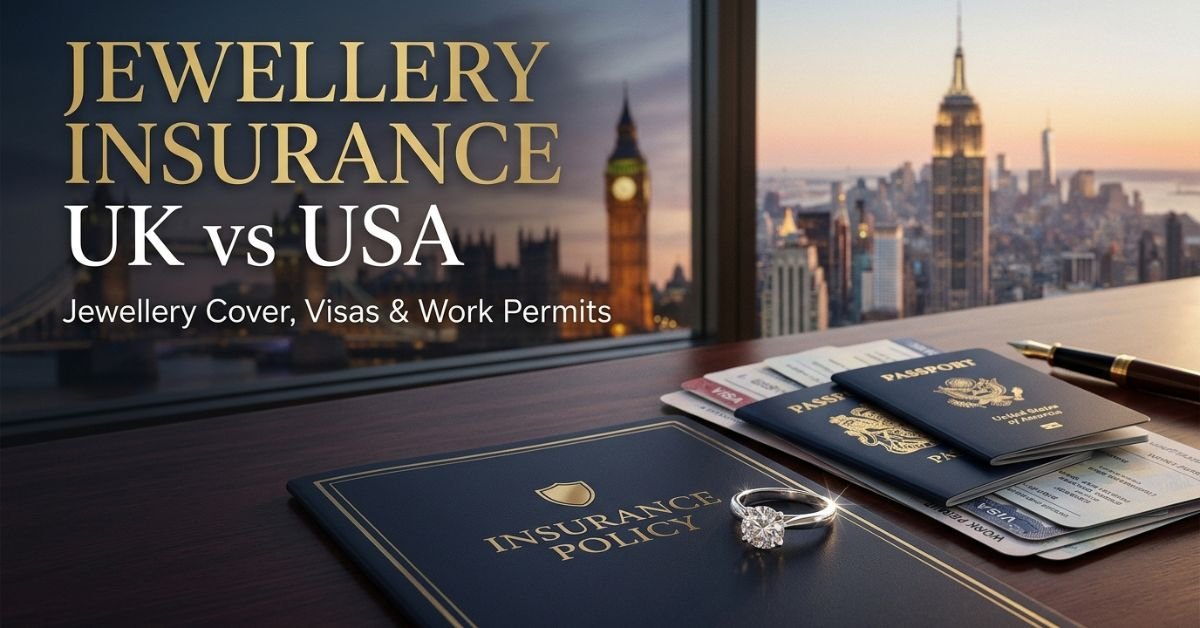
Jwellery Insurance UK vs USA
A ring slips from a finger during a busy day. A watch is left behind after a trip. A necklace is damaged while being stored.
These situations show why an insurance label alone cannot tell you what protection a piece of jewellery has. Jwellery Insurance UK vs USA is best compared by looking at the item, the covered events, the location, and the claim conditions in the specific policy.
A policy protects an item only within the limits and conditions that apply to it.
Featured-Snippet Answer
Jewellery cover in the UK and USA may be included in home insurance, but valuable pieces can have separate limits or conditions. Some policies let owners list or schedule an item for additional protection. Compare cover for theft, accidental loss, damage, travel, valuation, and the amount you may pay toward a claim.
Understand The Basic Difference
Jwellery Insurance UK vs USA: How The Systems Compare
In the UK, jewellery is often considered part of household contents. A home contents policy may protect belongings inside the home, while separate options can extend cover to items taken outside. A policy may also set a limit for one item or for a group of valuables.
In the USA, jewellery may be included in the personal property section of homeowners, renters, or condo insurance. A policy can have a special limit for jewellery, or a limit that applies only to certain kinds of loss. Owners may be able to list an item separately for a different limit or wider protection.
These descriptions explain common policy structures, not rules that apply to every insurer. The wording, location, and conditions of the actual policy matter more than the country name on the document.
A UK policyholder might encounter terms such as contents, specified items, valuables, or personal possessions. A US policyholder might see personal property, scheduled property, or an endorsement. Similar-sounding terms do not guarantee identical cover. Read what each section says it will pay for.
The main comparison is not simply “UK insurance versus US insurance.” It is standard household cover versus cover tailored to a valuable item. In either country, a policy that protects belongings generally may not be enough for an expensive ring, watch, or heirloom.
What Counts As Jewellery Or Jewelry
The UK spelling is usually “jewellery,” while “jewelry” is common in the USA. An insurance policy may cover rings, necklaces, earrings, bracelets, watches, precious stones, or other specified items. But definitions differ. One insurer may group certain pieces as valuables; another may treat watches, loose stones, sets, or collections separately.
That matters when an item has several parts. A necklace with a pendant, a pair of earrings, or a ring with multiple stones might be described as one piece or as several components. If the policy schedule uses a brief description, confirm that it identifies the item clearly enough.
Keep a personal inventory with a description of each item and how you use it. A ring worn every day, a watch carried while travelling, and a family necklace stored at home do not present the same practical coverage questions.

Four Questions To Ask First
Before comparing prices, find answers to these questions:
- What is the limit for one item? The policy’s overall contents or personal property amount may be much higher than the amount available for an individual piece.
- Which events are covered? Theft, accidental damage, accidental loss, and an item that goes missing without a clear explanation may be treated differently.
- Where does cover apply? Protection inside the home may not extend to daily wear, work, social events, or travel.
- What information might be required for a claim? The insurer may ask for details that help identify the item, explain what happened, and assess its value.
These questions can prevent a common misunderstanding: being covered for jewellery in general does not necessarily mean every item, loss, and location is covered in the same way.
Compare Policy Details
UK Contents Insurance Jewellery Limits
UK contents insurance may cover jewellery under a general household policy. The contract may also have limits for high-value items or valuables as a category. Depending on the policy, an item above a stated limit may need to be declared separately.
Check whether the policy distinguishes between:
- The total amount of contents cover.
- A combined amount for valuables.
- A maximum amount for a single item.
- Items covered only at the home.
- Items covered when carried outside.
- Loss, theft, and damage.
A high contents limit does not automatically remove lower limits for an individual ring or watch. Look at the relevant sections together. If an item needs to be specified, confirm that it appears correctly on the policy documents and that its description matches the piece you own.
Also check the meaning of any “personal possessions” or away-from-home option. It may be designed to extend protection beyond the home, but its scope depends on the contract. Does it apply while an item is worn? Does it include travel? Does it protect against accidental loss, or only certain events? These details cannot be assumed from the option’s name.
Jewelry Insurance USA: What Scheduling Means
In the USA, a policyholder may be able to schedule an item by listing it individually with a description and value. This can change the limit that applies to that piece and may change which events are covered. The details vary by insurer and policy.
Scheduling is not a blanket guarantee. An individually listed ring may still be subject to conditions, exclusions, a deductible, or rules about where it is covered. Before adding an item, ask how the added coverage differs from the standard personal property section.
Find out:
- Whether the item is named individually in the policy.
- What limit is attached to that item.
- Whether an appraisal or other documentation is needed.
- Which types of loss are included.
- Whether a deductible applies.
- Whether the item is protected away from home or abroad.
- What happens if its value changes over time.
Do not rely on a sales summary alone. The schedule and policy wording show how the item is described and what conditions apply.
Theft, Accidental Loss, And Damage Are Different
In everyday speech, people may describe an item as “lost” whether it was stolen, dropped, misplaced, or damaged. Insurance documents may draw clear distinctions between these situations.
A theft claim generally involves someone taking an item. Accidental loss might involve a specific event, such as a ring slipping into a drain. An item that has disappeared without the owner knowing when it went missing could be treated differently. Damage may have its own conditions, and gradual wear is not necessarily treated like a sudden accident.
When reviewing a policy, look for wording about:
- Theft from the home or elsewhere.
- Accidental loss while an item is being worn or carried.
- Unexplained disappearance or misplacement.
- Damage and repair.
- Wear, deterioration, or maintenance.
- Items left unattended or stored in a vehicle.
If the policy is unclear, describe a specific example to the insurer and ask how the cover would apply. “Is my ring covered?” is a broad question. “Would this policy respond if my ring slipped off while I was travelling?” is more useful.
Engagement Ring Insurance Abroad
A ring protected inside the home may not have the same protection while travelling. A policy might extend cover to other places, but the terms could vary by destination, trip length, storage, and type of loss.
Before travelling with a valuable piece, ask the insurer to clarify:
- Where the policy applies.
- Whether any trip-length limit exists.
- Whether the item is covered while worn and while stored.
- How the policy treats luggage, accommodation, or vehicles.
- Whether accidental loss is included.
- How quickly a loss should be reported.
- What documents or local reports may be needed.
Travel insurance may include some protection for belongings, but it should not be assumed to replace jewellery-specific cover. The limits and conditions could be different. Compare the policies and ask whether they overlap, work separately, or leave a gap.
For readers who live outside the UK and USA, the same questions remain useful even if local insurance terms differ. Check where an item is covered, what events count, and whether a valuable piece must be declared separately.
Appraisals, Receipts, And Valuation
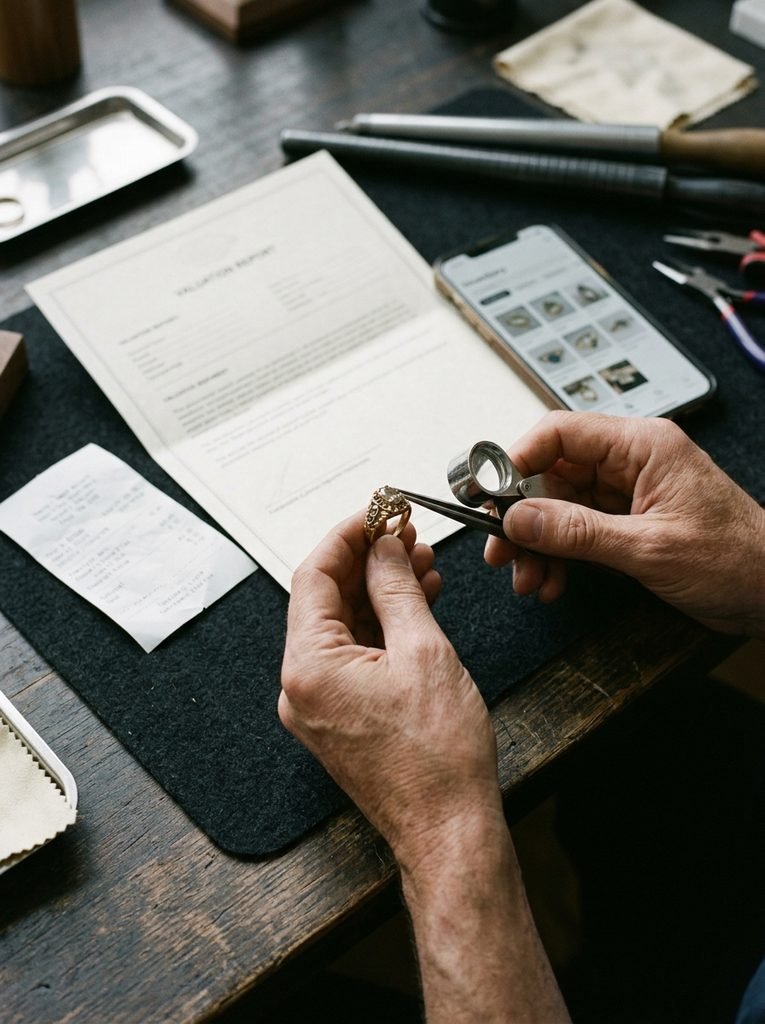
Insurance records should make it possible to identify an item and understand its value. A receipt can show when and where something was purchased, but it may not fully describe a custom-made piece or an item inherited from a family member.
An appraisal or valuation may provide a detailed description, but requirements differ. Ask whether one is needed, who can provide it, and whether there is a time limit after which it should be updated. Also find out whether the valuation is used as the coverage limit, as supporting information, or in another way.
A useful record can include:
- Clear photographs from several angles.
- A purchase receipt or valuation document.
- A description of materials, stones, maker, and distinguishing features.
- Records of repairs, resizing, or alterations.
- A copy of the policy schedule that lists the item.
Keep these records somewhere separate from the jewellery. If a loss occurs away from home, it may be helpful to access the documents without returning to the place where the item was stored.
Choose And Maintain The Right Protection
How Premiums, Deductibles, And Excesses Affect A Claim
The annual price is only one part of an insurance decision. A lower premium might come with a lower limit, a narrower range of covered events, or a larger amount payable by the policyholder after a claim.
UK policies often use the term excess. US policies commonly use deductible. Both refer broadly to an amount that the policyholder may have to contribute when making a claim, but how the amount is calculated depends on the contract.
Check whether the amount applies per claim, per item, or to a specific section of the policy. Ask whether listed or scheduled items have different terms from jewellery covered under the standard household policy.
Compare the likely out-of-pocket cost with the protection provided. If a claim would involve repair, replacement, or payment up to a limit, understand that process before buying. A price comparison is most useful when each option is being compared on similar terms.
Replacement Value Is Not Sentimental Value
An inherited ring can have deep personal meaning, but an insurance claim usually addresses a financial loss under the policy’s rules. It cannot replace the memories attached to the item.
Ask how the insurer would handle a piece that is rare, custom-made, or no longer available. Would it consider a similar replacement? Could it pay for a repair? Does the owner choose the jeweller, or does the insurer have a preferred process? The answers may vary.
This is especially relevant for:
- Antique pieces.
- Custom designs.
- Jewellery with unusual stones.
- Matching sets.
- Items that have been altered or repaired.
- Heirlooms without an original receipt.
A stated value can help define cover, but do not assume it promises payment of that amount in every situation. Read the claim settlement terms and ask what evidence will be needed.
Common Gaps That Cause Disappointment
A policyholder may be surprised if:
- A high-value item was not listed separately.
- The policy covers the item at home but not while it is worn elsewhere.
- Theft is covered, but accidental loss is not.
- A pair or set was described in a way that does not match the owner’s expectation.
- The available documentation does not clearly identify the item.
- A storage or security condition was not met.
- The policy’s repair or replacement process differs from what the owner expected.
- The trip or location falls outside the cover.
These possibilities are not a reason to expect a claim to be rejected. They are reasons to understand the contract before buying it. If a condition is unclear, ask for an explanation and keep the response with the policy records.
A Practical Buying Sequence
- List the pieces you want to protect. Include a description, estimated value, and how often each item is worn or carried.
- Read the existing household policy. Find the single-item limit, valuables limit, and sections for belongings outside the home.
- Ask whether an item should be listed separately. Confirm how it will appear on the policy schedule.
- Check the covered events. Ask separately about theft, accidental loss, damage, and unexplained disappearance.
- Review travel and location terms. Confirm where the policy applies and whether a trip-length limit exists.
- Understand the claim process. Ask about documents, reporting steps, deductibles or excesses, and repair or replacement.
- Compare the full cost and terms. Look beyond the price to the limits and conditions.
- Keep records current. Store photographs, descriptions, receipts, and policy documents in a secure location.
This process works for a UK, US, or international policyholder. The terms will differ, but the decisions are similar: identify the item, understand its limit, check where it is covered, and know what a claim could require.
Which Option Fits Your Situation?
If your jewellery is modest in value and usually stays at home: Start by reviewing your household policy. Check the relevant limits and confirm they fit the pieces you own. Additional cover may not be necessary if the existing terms already match your needs.
If you wear an expensive ring or watch every day: Pay close attention to cover outside the home and accidental loss. A policy designed around belongings kept at home may not fit an item that is worn daily.
If you have several valuable pieces: Check both the limit for each item and any combined limit for valuables. A policy might treat a ring and a watch differently from a group or collection.
If you travel regularly: Confirm where the cover applies, whether trip duration matters, and how the policy treats items left in luggage or accommodation. Do not assume the home policy and travel policy provide the same protection.
If the item is inherited, rare, or custom-made: Keep detailed records and ask how the policy would assess repair or replacement. A description and photographs can be particularly useful when there is no ordinary retail receipt.
If you are comparing policies across countries: Focus on the contract features rather than the labels. “Contents,” “personal property,” “specified,” and “scheduled” can refer to different structures. Ask the insurer to explain the practical difference for the item you want to protect.
What To Watch Next
Policy documents can change when a policy renews, when an item is added, or when the owner moves or starts travelling more often. Revisit the schedule whenever you buy a high-value piece, inherit jewellery, change how you use an item, or discover that its documented value is no longer suitable.
Keep a copy of any written confirmation from the insurer. If a representative explains a condition by phone, ask where the same information appears in the policy documents or request written clarification. That record can help you understand the cover later.
No general comparison can determine whether a particular ring or watch is insured. The policy wording, schedule, and the circumstances of a loss control the answer. For that reason, the most useful next step is to check the actual documents for your own item.
Summary Comparison Table
| Question | UK Policyholder | US Policyholder | Any Country |
|---|---|---|---|
| Where might jewellery be included? | Often under home contents cover | Often under homeowners, renters, or condo personal property cover | Check the relevant household policy |
| What limit matters? | Single-item and valuables limits | Special jewellery limits and item-specific limits | Find both individual and combined limits |
| When might extra cover help? | When an item exceeds a limit or needs away-from-home protection | When standard personal property terms are insufficient | Compare added cover against the item’s use |
| What records should be kept? | Description, photographs, proof of ownership, policy schedule | Description, photographs, proof of ownership, item schedule | Keep secure copies accessible after a loss |
| What should be checked before travel? | Location, trip length, accidental loss, storage terms | Location, trip length, accidental loss, storage terms | Confirm the cover applies to the actual journey |
Frequently Asked Questions
Does a home insurance policy automatically cover jewellery outside the home?
Not always. Some policies focus on belongings kept at the insured home, while others offer an option for items carried elsewhere. Check whether the policy covers the item while worn, whether accidental loss is included, and whether any travel conditions apply.
Should I list every ring and watch separately?
That depends on the policy’s limits and the value of each piece. Some items may fit within standard cover, while others may need to be identified individually. Ask the insurer what should be listed and confirm that the policy schedule reflects the answer.
Can travel insurance replace jewellery-specific cover?
Not necessarily. Travel insurance may protect some belongings, but its limits, covered events, and claim conditions may differ from those of jewellery-specific protection. Compare both documents and ask whether a valuable piece is covered in the situations you expect.
What information should I save for an inherited piece?
Keep photographs, a written description, any appraisal or valuation, and records of repairs or alterations. If there is no purchase receipt, ask the insurer what alternative evidence it accepts when adding the item to a policy.
Will an insurer pay the full value shown on an appraisal?
Do not assume so. The appraisal can help describe the item and its value, but settlement depends on the policy’s limits and claim terms. Ask whether the document sets the insured amount or serves as supporting evidence.