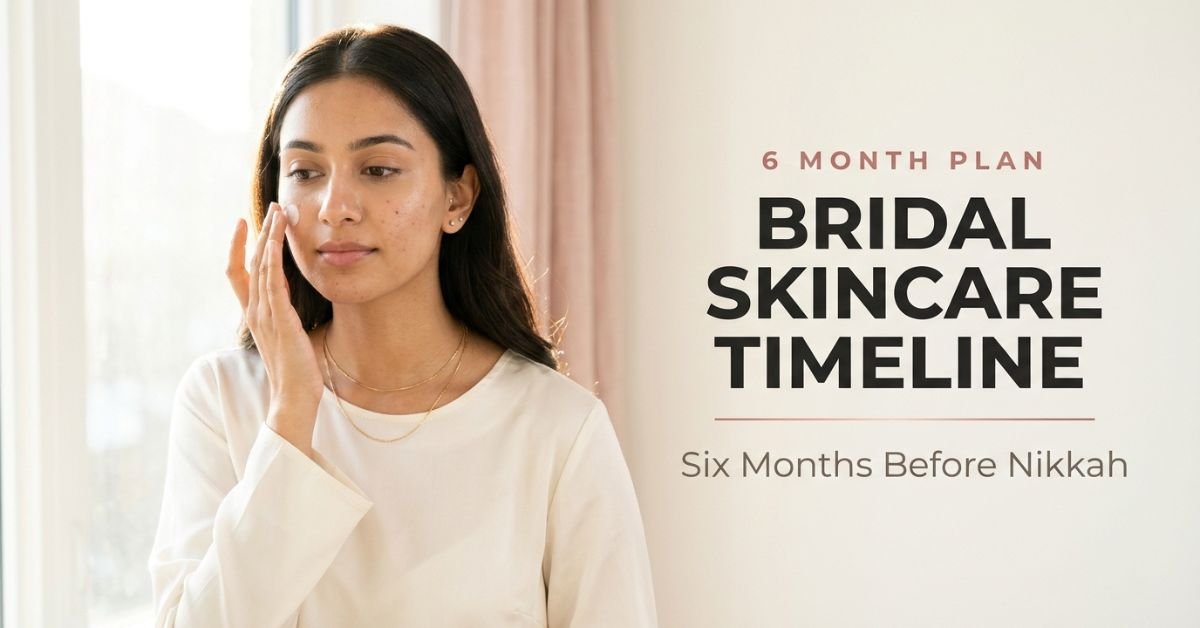
Bridal Skincare Timeline: Six Months Before Nikkah
Skin renews itself on a cycle of roughly a month, which means that between today and your nikkah there are only about six of those cycles left. Six. That is the entire budget, and every serum, peel and clinic session has to be paid for out of it. Once you see the window that way, the planning question changes completely: a bridal skincare timeline is not a list of things to buy, it is a schedule of how long each thing takes and how late it can safely be done. The second half of that sentence is where most brides go wrong.
QUICK ANSWER
A six-month bridal skincare timeline splits into three phases. Months six to four are for correction start actives, treat acne or pigmentation, begin any clinical course. Months three to two are for consolidation no new products, maintain gains, wind down strong treatments. The final month is for calm hydration, rest and gentle care only.
Key Takeaways
- Anything that resurfaces the skin belongs in the first half of your timeline, never the last six weeks.
- Never introduce a treatment, brand or salon you have not already tested once the eight-week mark passes.
- Pigmentation is the slowest thing to correct and the quickest to return; sunscreen is what protects the work, not the serum.
- Book your final facial about a week to ten days out, not the night before.
- Skip unregulated instant-lightening products entirely. The rebound often lands squarely in your wedding week.
Bridal Skincare Timeline At A Glance: The Six Month Map
Everything below expands on this table. If you save one thing from this article, save this.
| Months Out | Phase | Begin | Stop |
|---|---|---|---|
| 6 | Assessment | Professional skin consultation, baseline photos, daily sunscreen, barrier repair | Product-hopping and impulse buys |
| 5 | Correction Opens | One active introduced slowly, treatment plan for acne or pigmentation, first clinical session if advised | Harsh scrubs, kitchen remedies, aggressive at-home tools |
| 4 | Tolerance Building | Increase active frequency, second clinical session, morning antioxidant | Adding a second new active in the same month |
| 3 | Peak Correction | Final strong sessions, body and back care, sleep and nutrition discipline | Any first-time procedure you have never had |
| 2 | Consolidation | Maintenance facials every three to four weeks, hydration focus, product list locked | New brands, new salons, new formulas — total freeze |
| 1 | Calm And Protect | Gentle hydrating care, familiar masks, earlier nights | Peels, resurfacing, strong exfoliants, experiments |
| Final 7 days | Hold Steady | Cleanse, moisturise, protect, sleep, drink water | Everything else |
Diagnose Before You Spend Anything
Begin with a diagnosis, not a shopping cart. Dull skin, active acne, leftover marks from old breakouts, patchy pigmentation, rough texture, enlarged pores and simple stress-related dryness all look vaguely similar in a mirror and respond to completely different things. Choosing the wrong target and pursuing it faithfully for half a year is the quietest way to arrive at your nikkah disappointed despite having done a great deal.
If you live with something chronic persistent acne, sensitive or reactive skin, eczema, a hormonal pattern of breakouts get it medically stable now, while there is still room to adjust. Skin conditions do not respond to urgency. They respond to time and consistency, and both are cheapest when you have six months of them.
Three foundations to fix in place this month:
- A sunscreen you will actually wear every morning. Broad-spectrum, at least SPF 30, texture you enjoy enough to reapply. Nothing else in this plan works properly without it.
- A gentle cleanser and a moisturiser your skin already tolerates. Repair the barrier first; actives come second and work better on calm skin.
- Monthly reference photos, same light, same angle, no makeup. Skin improves too gradually for memory to judge it fairly.
The Ingredient Lead Time Table
This is the engine of any serious pre wedding skincare routine — knowing how long an ingredient needs to earn its place, and the point at which it becomes a liability rather than an asset.
| Active | Best For | Realistic Time To Visible Change | Introduce By | Pause Before Nikkah |
|---|---|---|---|---|
| Retinoid or retinol | Texture, congestion, tone, fine lines | Two to three months for clarity; longer for lines | Month 5 | Stop about a week before |
| Vitamin C | Radiance, antioxidant defence | Four to eight weeks | Month 5 | Safe to continue |
| Niacinamide | Redness, oil balance, barrier support | Four to eight weeks | Any month | Safe to continue |
| Azelaic acid | Breakouts plus the marks they leave | Two to three months | Month 5 | Safe to continue |
| AHA or BHA exfoliant | Dullness, blocked pores | Four to six weeks | Month 5 | Stop ten to fourteen days before |
| Hyaluronic acid and ceramides | Hydration, plumpness, comfort | Days | Any month | Continue through the day itself |
| Prescribed pigmentation therapy | Stubborn melasma or dark patches | Three to six months, medically supervised | Month 6 | As your doctor directs |
Two rules govern this phase and neither is negotiable. Introduce one new active at a time, roughly a month apart, so that a reaction can be traced to a single culprit. And expect the road to dip before it rises. Anything that speeds up cell turnover tends to surface congestion that was already forming under the surface, which is exactly why this belongs at month five rather than month two — you want the rough patch to happen while nobody is photographing you.
Professional Treatments And Their Cut Off Dates
Clinic work produces the visible step-change that most brides are hoping for, and it also carries every risk in this timeline. Treat the table below as a booking rule rather than a suggestion.
| Treatment | Ideal Start | Sessions Typically Needed | Last Session Before Nikkah | Reason For The Cut-Off |
|---|---|---|---|---|
| Superficial chemical peel | Month 5 | Three to six, spaced three to four weeks | Three to four weeks out | Flaking and lingering pinkness |
| Microneedling | Month 5 | Three to four, spaced four weeks | Four weeks out | Redness and short-term swelling |
| Pigment-targeting light or laser | Month 6 | Three to six, spaced four weeks | Four to six weeks out | Risk of darkening after healing |
| Mechanical resurfacing | Month 4 | Three to four | At least two weeks out | Skin should not be mid-renewal |
| Hydrating or oxygen facial | Month 2 | Monthly | Seven to ten days out | Lets extractions and any purge settle |
| Injectables, if already familiar | No later than month 6 | As advised | Four to six weeks out | Settling time plus room to adjust |
One caution deserves emphasis, and it applies with particular force to medium and deep skin tones: heat, light and aggressive resurfacing can trigger darkening that appears after the skin has healed, not during. That mark can take months to fade far longer than the treatment took to perform. Choose a practitioner who works regularly with skin like yours, insist on a test patch in an inconspicuous area, and refuse any package that compresses a six-session course into eight weeks because the date is approaching. Compression is where the damage happens.
Body composition belongs in this conversation too, because rapid change shows on the face. Aggressive last-minute dieting tends to surface as breakouts, dullness and hair shedding. If weight is part of your plan, begin it gradually at the three-month mark rather than crash-running it in the final six weeks.
Months Two And One: The Freeze
From eight weeks out, your role changes from improving your skin to defending it. Nothing new enters the routine. Nothing new touches your face. The instinct to keep optimising is strong at exactly this point, and it is the instinct to resist.
The freeze is broader than skincare:
- No new cleanser, serum, mask, sunscreen or moisturiser.
- No unfamiliar salon and no unfamiliar therapist, however good the reviews.
- No first-time lash extensions, tints or bleaches. First exposures are where allergic reactions happen, and they happen without warning.
- No new makeup. Run your trial using the exact products that will be on your face during the ceremony.
- No experimental supplements or detox teas marketed for a bridal glow.
If something genuinely must be tested, patch it behind the ear or on the inner forearm and give it a full fortnight before it goes anywhere near your face.
Grooming And Hair Removal: The Days Out Table
Here the unit of measurement is days, not months, and errors show up in every photograph taken that week.
| Service | When To Book | Why |
|---|---|---|
| Brow shaping | Around two weeks out, with stray hairs tidied a day or two before | Avoids puffiness and localised redness |
| Facial hair removal | Seven to ten days before | Gives irritation time to settle completely |
| Body hair removal | At least three days before, earlier for sensitive or first-time skin | Never the day before, under any circumstances |
| Laser hair reduction | Course completed two to four weeks out | Needs several sessions started from month six |
| Final facial | Seven to ten days out | Hydrating only, no heavy extractions |
| Teeth whitening | Two to three weeks out | Sensitivity subsides in time |
For a wedding built from several functions, count backwards from the first event rather than the last. If there is a mehndi on Thursday and the nikkah on Saturday, Thursday is your real deadline. Plan the space between functions deliberately too: thorough but gentle cleansing at night, a hydrating mask you have used before, and nothing more ambitious than that. Long hours in heavy makeup dehydrate skin far more than most brides expect.
Climate is worth one line of adjustment. In humid heat, favour lighter gel textures and reapply sunscreen more often. In dry cold, layer a richer occlusive at night and lower exfoliation frequency, because barrier damage happens faster than most people notice. Air travel before the wedding compounds both hydrate before the flight, not after landing.
The Lightening Cream Warning Most Bridal Guides Skip
This section explains why some brides finish six diligent months with worse skin than they started with.
Unlabelled, salon-mixed or informally sold “instant fairness” creams circulate in bridal markets worldwide, not in one country alone. Their appeal is speed, and speed in pigment correction almost always means one of two things: a potent steroid, or a heavy-metal or unapproved lightening agent. Both suppress pigment temporarily. Both thin and destabilise the skin while doing it. And both are prone to rebound — pigment returning, often patchier and darker than before, on a timeline that has a cruel habit of landing in the wedding week.
| Warning Sign | Why It Matters | Safer Alternative |
|---|---|---|
| No ingredient list, no batch code, no manufacturer | Nothing can be verified, reported or reversed knowledgeably | Sealed products with complete ingredient labelling |
| Claims of visible fairness within days | Genuine pigment change is measured in weeks | Products that state realistic four-to-eight-week timeframes |
| Mixed for you personally in a shop or salon | Unregulated compounding, unknown potency | Only formulations prescribed by a qualified doctor |
| Burning, thinning, visible small vessels or increased hair growth | Classic signs of prolonged potent steroid use | Stop immediately and seek medical review |
| Sold only through private messages or personal pages | No accountability, no recourse | Licensed pharmacies and established retailers |
Ingredients that genuinely even skin tone exist, and every one of them is slow: niacinamide, azelaic acid, vitamin C, gentle exfoliating acids, and prescription options used under supervision. All of them depend entirely on daily sun protection to keep what they achieve. A brightening routine without sunscreen is a bucket with a hole in it.
Wedding Week: The Short List
Seven days out, the plan should look almost dull. That is the point.
- Cleanse, moisturise, protect. Nothing unfamiliar.
- Retire retinoids and strong exfoliants roughly a week ahead so no flaking meets your foundation.
- Treat sleep as a skincare step and defend it more fiercely than your seating plan.
- Watch salt, alcohol and very late nights — puffiness is far easier to prevent than to fix.
- If a spot appears, do not attack it. Use the treatment your skin already knows, keep the area hydrated, and let your makeup artist handle the rest. Squeezing turns a two-day problem into a two-month mark.
- On the morning itself: light moisturiser, no scrubs, no very hot water, no new product of any kind.
Who Should Start Today, And Who Can Wait
If you are dealing with active acne, visible scarring, established pigmentation, or you are considering any clinical procedure for the first time, begin this week rather than next month. These concerns need the full six months, they need professional input, and there is no shortcut that does not carry a cost. Book the consultation before you book anything else on your wedding list.
If your skin is broadly healthy and your goal is simply to look rested and even-toned, you can comfortably wait until the four-month mark. Your plan is short and it works: sunscreen every morning, a moisturiser you like, one well-tolerated active, a monthly gentle facial from month three, and a complete freeze on anything new from week eight.
And if you are already inside eight weeks, close the treatment menus. Hydrate, sleep, protect, and use only what your skin already trusts. At that distance, restraint outperforms ambition every single time and calm, well-hydrated skin photographs better than skin that has been rushed.
FAQ
How Early Should A Bridal Skincare Timeline Really Begin?
Six months is the practical minimum if you want to correct something specific, and a year is better for scarring or long-standing pigmentation. Under three months, the objective shifts from correction to protection — and even that shift makes a visible difference by the day itself.
Can I Start A Retinoid Two Months Before My Nikkah?
It is a poor trade. The first weeks typically bring dryness and surfacing congestion, and the benefits arrive after that phase ends. Starting two months out means peak irritation coincides with your functions. Choose azelaic acid or niacinamide instead within that window.
Is A Facial Safe The Day Before The Ceremony?
No. Extractions, massage and unfamiliar products can leave redness, small bumps or reactive patches lasting well beyond a day. Schedule the last facial seven to ten days out and keep it hydrating rather than resurfacing.
Do I Need Expensive Treatments To Look Good On The Day?
No. The three highest-return habits are daily sun protection, consistent moisturising and adequate sleep. Clinical treatments accelerate specific corrections, but they cannot substitute for the basics, and rushed courses often cost more than they give.
What Should I Do If I Break Out During Wedding Week?
Stay with the treatment your skin already knows, keep the area hydrated, and do not squeeze. A warm compress can help a surface spot settle. For anything severe or painful, a doctor can sometimes treat individual lesions directly — that is a medical decision, not a salon one.
Does The Plan Change For Oily Versus Dry Skin?
The timeline itself does not change at all; only the textures do. Oily skin does better with gel moisturisers, niacinamide and a salicylic exfoliant. Dry skin needs richer creams, ceramides and less frequent exfoliation. Both follow the same sunscreen habit and the same eight-week freeze.