
Engagement Ring Insurance: Cost Coverage And Providers
For somewhere between one and two percent of its value each year, an engagement ring can be fully protected against being lost, stolen, crushed in a car door or dropped through a grate on a street corner. That is the entire cost of the decision. Most people still don’t make it.
The reason isn’t carelessness. It’s that a ring feels like jewellery rather than an asset, and jewellery feels like something the household policy already handles. It usually doesn’t — and the discovery tends to arrive at the worst possible moment.
The Short Answer
Engagement ring insurance typically costs one to two percent of the ring’s assessed replacement value each year. A dedicated policy covers loss, theft, accidental damage and unexplained disappearance, usually anywhere in the world. Standard home contents policies cap jewellery at a low per-item figure and often exclude simple loss altogether.
Key Takeaways Before You Read Further
- A general home or contents policy rarely protects a ring properly. The per-item limit is the obstacle, not the insurer.
- Expect an annual premium of roughly one to two percent of assessed value. Specialists sometimes price below that.
- Insurers work from a replacement valuation, not your purchase receipt — and the two are rarely the same number.
- The most costly error is not going uninsured. It’s carrying a policy built on a valuation that quietly went out of date.
- The words that matter in any quote are all-risk, worldwide and unexplained disappearance. Everything else is detail.
You Assume Your Home Policy Already Covers The Ring
The symptom. There’s a ring of real value in the household, there’s a home or contents policy in force, and nobody has ever checked whether the two are connected.
The cause. Contents policies do include jewellery — but they apply a single-article limit, a ceiling on how much will be paid for any one item. In most markets that ceiling is set low, because it’s calibrated for watches, chains and earrings rather than for a piece that may represent a month or more of household income. Anything above the ceiling is, in practical terms, uninsured.
A second restriction usually sits underneath the first. Many base policies protect belongings only against named events — fire, flood, forced-entry theft. Losing an item is not an event on that list. Neither is snapping a setting against a door frame.
The fix. Two routes exist almost everywhere, though the vocabulary changes by country. You can list the ring individually on your existing policy — called a rider, floater or endorsement in North America, and specified-item or specified personal possessions cover across the UK, Ireland, Australia and much of Europe. Or you can buy a standalone jewellery policy that sits entirely outside your household insurance.
How to confirm it worked. Open your policy schedule. The ring should appear as a separately named item with its own value beside it. If you cannot point to it on the page, it is not specified — regardless of what was said on a call.
The Ring Is Insured, But For The Wrong Number
The symptom. The policy is genuine. The claim is accepted. The settlement still falls short of what an equivalent ring now costs.
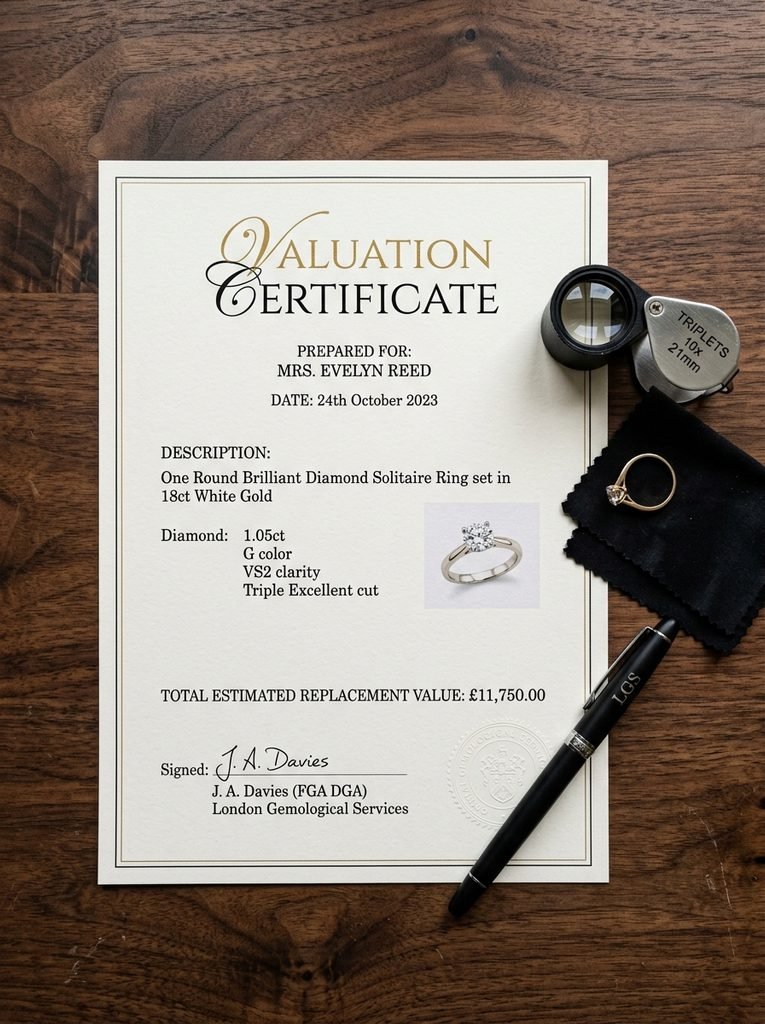
The cause. A receipt records what you paid at a particular shop on a particular day, after whatever margin, discount or promotion applied. A replacement valuation records something different: what it would cost to have that ring made or sourced again at today’s retail prices. The second figure is usually the larger one, sometimes substantially.
Then the number ages. Precious metal prices move. Stone markets shift. Currencies move against each other, which matters a great deal if the stone would be sourced internationally. A valuation written four years ago describes a ring that no longer costs what the document says.
The fix. Obtain a written replacement valuation from a qualified independent valuer before the policy is finalised. It should specify carat weight, cut, colour and clarity for the main stone, the metal type and weight, the setting style, and any laboratory grading report number attached to the stone.
Then decide who is responsible for keeping that figure current. Some insurers uplift insured values automatically at renewal. Others expect you to initiate it. The distinction is not always obvious in the paperwork.
How to confirm it worked. Two quick checks. The valuation date should be within the last two to three years. And the sum insured on your schedule should match the valuation figure exactly — not the receipt, and not a convenient round number.
The Quote Came Back Higher Than You Expected
The symptom. You had budgeted for pocket change. The figure on the screen is several times that.
The cause. Premiums are not flat rates. They are calculated from assessed value, the loss and theft history of your postcode or district, the excess or deductible you selected, and whatever discounts you qualify for. Two identical rings in two cities can generate meaningfully different quotes.
The underlying arithmetic, though, is simple and holds across currencies.
Engagement Ring Insurance Cost At A Glance
| Assessed Value (any major currency) | At ~1% Annually | At ~2% Annually | Roughly Per Month |
|---|---|---|---|
| 2,000 | 20 | 40 | 2 – 3 |
| 5,000 | 50 | 100 | 4 – 8 |
| 10,000 | 100 | 200 | 8 – 17 |
| 25,000 | 250 | 500 | 21 – 42 |
| 50,000 | 500 | 1,000 | 42 – 83 |
What moves your number up or down:
- Excess or deductible. A nil-excess policy costs more each year but pays small repair claims. A high excess lowers the premium and makes minor claims pointless to file.
- Where you live. Districts with higher recorded theft frequency price higher, sometimes sharply.
- Security measures. A monitored alarm, a home safe, or storage in a bank vault when the ring isn’t worn can each reduce the rate.
- Documentation quality. A certified laboratory grading report often earns a discount, because it makes replacement far easier for the insurer to specify.
- Payment frequency. Paying annually rather than monthly commonly carries a modest saving.
The fix. Collect three quotes — one from your existing household insurer for adding the ring as a specified item, and two from specialist jewellery insurers. Most specialist quotes take minutes. If the result is uncomfortable, adjust the excess rather than reducing the sum insured. Cutting the sum insured saves money by making the policy worse at the only job it has.
How to confirm it worked. Divide the annual premium by the sum insured. Comfortably below two percent means you’re inside normal market pricing. Well above it means either a genuinely high-risk location or insufficient shopping.

You Can’t Decide Between An Add-On And A Standalone Policy
The symptom. Both options cover the ring. Prices land close together. Nothing obvious separates them.
The cause. The meaningful difference isn’t the premium or the peril list. It’s what a claim does to the rest of your insurance.
When a ring is specified on your household policy, a claim against it is recorded as a household claim. In most markets, insurers share or retain claims history, and that entry follows you into every future renewal and every quote from a competitor. Household insurance has become steadily harder and more expensive to place in many regions, and one avoidable entry on your record is worth avoiding.
A standalone jewellery policy keeps that event in a separate file. It is not a household claim, because the insurer is not your household insurer.
The excess question matters too. An item added to a household policy frequently inherits that policy’s excess, which can make a modest repair claim uneconomic to pursue. Dedicated jewellery policies more often carry a nil or very low excess.
Add-On Versus Standalone: The Honest Comparison
| Factor | Specified Item On Home Policy | Standalone Jewellery Policy |
|---|---|---|
| Typical premium | Sometimes marginally cheaper | Competitive, occasionally lower |
| Excess / deductible | Often the household excess | Frequently nil or minimal |
| Unexplained disappearance | Depends entirely on the insurer | Usually included as standard |
| Effect on household claims record | Recorded as a household claim | Kept separate |
| Cover away from home | Sometimes reduced or capped | Normally worldwide |
| Administration | One insurer, one renewal | A second policy to manage |
| Best suited to | Lower-value rings, simple households | Most engagement rings |
The fix. If the ring sits near the lower end of the value range, your insurer confirms unexplained-disappearance cover in writing, and the excess is small, adding it to the household policy is reasonable. For most engagement rings, a dedicated policy is the better instrument.
How to confirm it worked. Ask one direct question before signing: “If I claim on this, is it recorded against my household insurance history?” The answer determines which product you should actually be buying.
The Providers All Look Identical
The symptom. Several quotes open in several tabs, all promising comprehensive protection, with no visible basis for choosing between them.
The cause. They genuinely do cover a similar list of perils. What separates them is how they settle claims, whether they keep values current, and which kind of customer they were built for. Availability also varies enormously by country, which is why it’s more useful to recognise provider types than to memorise brand names.
Engagement Ring Insurance Providers Compared
| Provider Type | How It Works | Strengths | Watch For | Best Suited To |
|---|---|---|---|---|
| Specialist jewellery insurers (e.g. Jewelers Mutual, BriteCo, Lavalier in North America; specialist jewellery schemes underwritten through Lloyd’s and similar markets elsewhere) | Jewellery is the only thing they write | Deep claims expertise, usually all-risk and worldwide, often nil excess | Availability is country-specific; confirm they operate where you live | Most engagement rings, and almost all custom or unusual pieces |
| High-net-worth / private client insurers (e.g. Chubb and comparable private-client divisions) | A single schedule covering a whole collection | Agreed-value settlement, generous limits, bespoke service | Minimum premiums and asset thresholds can be high | Collections, multiple high-value pieces, significant heirloom sets |
| Mainstream home insurers’ specified-item cover | The ring is listed individually on your existing policy | Simple, one insurer, often bundled discounts | Shared excess; claims land on your household record | Lower-value rings and readers who want a single provider |
| Digital and app-based insurers | Cover bought and managed entirely in an app, often as an add-on to renters or contents cover | Fast quotes, low friction, transparent pricing | Younger claims operations; check how a complex replacement is handled | Renters and first-time buyers with mainstream, replaceable rings |
| Jeweller-administered protection plans | Sold and run by the retailer that made or supplied the ring | Repairs handled by the original maker; sometimes no separate valuation needed | Not always regulated insurance; scope can be narrower than it appears | Buyers who want the original jeweller to handle everything |
| Bank, card and membership schemes | Jewellery cover bundled into a packaged account or premium card | Effectively free if you already hold the product | Low single-article limits, restrictive conditions | Supplementary cover only — rarely sufficient alone |
Product availability, regulation and terms differ significantly between countries. Confirm current details directly with any provider before committing.
The fix. Match the provider to the ring rather than to the advertising. A widely produced solitaire is a commodity replacement — speed and price are the deciding factors. A hand-made setting, an antique stone or a piece with sentimental provenance needs an insurer whose claims team can realistically recreate it rather than hand you a cheque and a catalogue.
How to confirm it worked. Ask how a claim on your particular ring would be settled: cash, replacement through the insurer’s own network, or reimbursement through a jeweller of your choosing. If that answer doesn’t match how you would actually want the ring replaced, keep looking
The Claim Gets Refused Or Underpaid
The symptom. Cover was in force, the loss was real, and the outcome was still a refusal, a reduction, or a months-long argument.
The cause. Refusals usually trace back to one of four things: missing documentation, an excluded cause of loss, an unmet policy condition, or a disputed valuation.
Almost every jewellery policy excludes ordinary wear, gradual deterioration, and stones lost from prongs that thinned over years of use. Damage already noted on the original valuation is excluded as pre-existing. Deliberate damage is excluded everywhere. And higher-value items frequently carry conditions — a required safe, a periodic inspection, a security specification, or a rule about removing the ring during certain activities. A breach of a condition can undermine an otherwise valid claim.
The fix. Assemble the claim file before you need it. One folder, held both digitally and physically, containing the written valuation, the purchase receipt, the laboratory grading report if one exists, and sharp photographs of the ring from multiple angles.
Then read your own policy conditions once, properly, searching for the words must, required and within. Obligations live in those sentences, not in the summary page.
How to confirm it worked. Ask whether a stranger could identify and price your exact ring from your documentation alone, with you not in the room. If the answer is no, the file isn’t finished.
It’s Protected At Home, Not Where You Actually Wear It
The symptom. The ring disappears abroad, at a swimming pool, in a changing room or through an airport tray — and the policy turns out to have geographic or situational boundaries.
The cause. Household cover is anchored to an address. Protection for belongings taken outside that address is often reduced, capped, limited to a certain number of days abroad, or excluded entirely unless specifically added.
Then there is unexplained disappearance — the ring is simply gone, with no theft, no witness and no account of what happened. It is the most common way a ring is actually lost, and one of the first things a basic contents policy declines to cover. Specialist jewellery insurers generally build it in as standard.
The fix. Get three things confirmed in writing before you buy: worldwide cover, all-risk rather than named-events cover, and explicit inclusion of unexplained disappearance. An all-risk policy covers everything except what it specifically excludes, which is a fundamentally stronger position than a policy listing what it will pay for.
How to confirm it worked. Find the exclusions section — not the brochure, the actual wording — and read it end to end. On a well-built all-risk policy, that list is short and specific. A long, vague exclusions list is the real price of a cheap quote.
The Insurance Timeline: When Each Step Should Happen
- Before the proposal — the buyer insures the ring in their own name. Cover should begin the day it leaves the shop, not the day it’s worn.
- Within the first month — obtain a full written replacement valuation if the jeweller did not supply one.
- Within two months — place the permanent policy and file the documentation properly.
- After the engagement — decide whether the policy transfers to the wearer or remains with the buyer, and formally update the named policyholder.
- After the wedding — review household cover as a whole, including the wedding band and any gifted jewellery.
- Every two to three years — revalue, or confirm in writing that your insurer uplifts the sum insured automatically.
- After any repair, resize or stone replacement — update the valuation. The ring has changed; the paperwork should follow.
Who Should Act Now, And Who Can Reasonably Wait
Act this week if the ring is worth more than your policy’s single-article limit, if no written valuation exists, if the piece is an heirloom or custom-made and could not simply be reordered, or if the wearer travels regularly. In each case the exposure is live today and closing it is inexpensive.
Act, but without panic, if the ring’s value sits close to your existing limit and it rarely leaves home. Specify it properly, but take a fortnight to compare quotes carefully instead of accepting the first one offered.
You can reasonably wait if the ring genuinely falls below your single-article limit, your policy is all-risk rather than named-events, cover extends away from the home, and you have personally read the schedule to confirm all three. That combination is uncommon — but it does occur, and nobody earning commission on a policy is going to mention it.
One limitation worth stating plainly: insurance products, regulation, terminology and pricing vary between countries and change over time. What’s described here is how this category of cover is structured and what determines whether it performs when tested. It is not a quote and not advice about a specific policy. Read the wording, ask the awkward questions, and get the important answers in writing before you commit.
Frequently Asked Questions
Do You Need A Valuation To Insure An Engagement Ring?
In most cases, yes. Insurers set the sum insured from a written replacement valuation, and many will accept a detailed purchase receipt instead if it fully describes the stone and metal. Some insurers waive formal inspection below a set value, but the ring still needs documentation specific enough to replace it accurately.
Who Should Hold The Policy Before The Wedding — The Buyer Or The Wearer?
Whoever legally owns the ring at that moment. The buyer should insure it from the day of purchase, under their own name, before the proposal. After the engagement, most insurers will transfer the policy or reissue it to the wearer. Treat that transfer as a task to complete, not something that happens by itself.
Is A Laboratory-Grown Diamond Insured Differently From A Mined One?
The policy mechanics are identical, but the valuation behaves differently. Laboratory-grown stone prices have moved considerably in recent years, so an older valuation may sit well above or below current replacement cost. Revalue these more often than you would a mined stone.
Does A Policy Cover Damage That Happens During Repair Or Resizing?
Usually not. While the ring is in a jeweller’s possession, responsibility normally sits with the jeweller rather than your insurer. Ask the jeweller to confirm their own cover before handing it over, and take a written receipt describing the ring’s condition on the day.
What Happens If The Ring Turns Up After A Claim Has Been Paid?
It depends on the wording. Many insurers take ownership of the item once they have settled, and will offer you the chance to buy it back at the settlement figure. Read that clause before you file, not afterwards.