Smile Makeover Cost 2026: What A Full Transformation Involves
Most people begin this search in exactly the wrong place. They look up what a single veneer costs, land on a number somewhere near the middle of the range, multiply it by eight teeth, and walk into a consultation carrying a figure in their head.
Then the treatment plan lands, and it is nearly double.
Nobody has been dishonest. The per-tooth figure was accurate. It simply was not the price of a smile makeover, because a smile makeover is not a product with a unit price. It is a coordinated plan, assembled around one specific mouth, and the difference between the number you calculated and the number on the page is where the whitening, the gum reshaping, the two teeth that needed crowns rather than veneers, the temporaries and the night guard were sitting all along.
What Does A Smile Makeover Cost In 2026
A smile makeover in 2026 typically costs between $1,000 and $50,000. A whitening and bonding refresh sits at the bottom of that band, a six to ten tooth porcelain plan occupies the middle at roughly $8,000 to $25,000, and comprehensive work involving implants or bite correction reaches the top. Region and case complexity drive most of the difference.
That spread looks absurd until you accept that the phrase covers two entirely different kinds of appointment. One patient books a single afternoon, has four front teeth polished, whitened and lightly reshaped with resin, and leaves the same day. Another begins a staged eight-month rebuild involving gum therapy, alignment, two implants and twelve ceramic restorations. Both describe what they had as a smile makeover, and both are right.
Placing yourself in the correct tier matters far more than finding a national average, because the average describes almost nobody. A rough map of the tiers:
A light refresh, meaning professional whitening with bonding on two to four teeth, generally runs $1,000 to $4,000. A moderate plan, combining whitening with four to six ceramic restorations, tends to land between $5,000 and $15,000. A full smile zone rebuild across eight to ten upper teeth commonly reaches $12,000 to $28,000. Once both arches, implants or bite reconstruction are involved, budgets of $30,000 to $70,000 stop being unusual.
Why Does The Same Smile Cost So Much More In One Clinic Than Another
Four variables explain nearly all of it, and none of them is greed.
The first is how many teeth you are treating. Six is not eight, and eight is not sixteen. Every additional tooth carries its own laboratory fee, its own chair time and its own material cost, and none of that scales down much with volume.
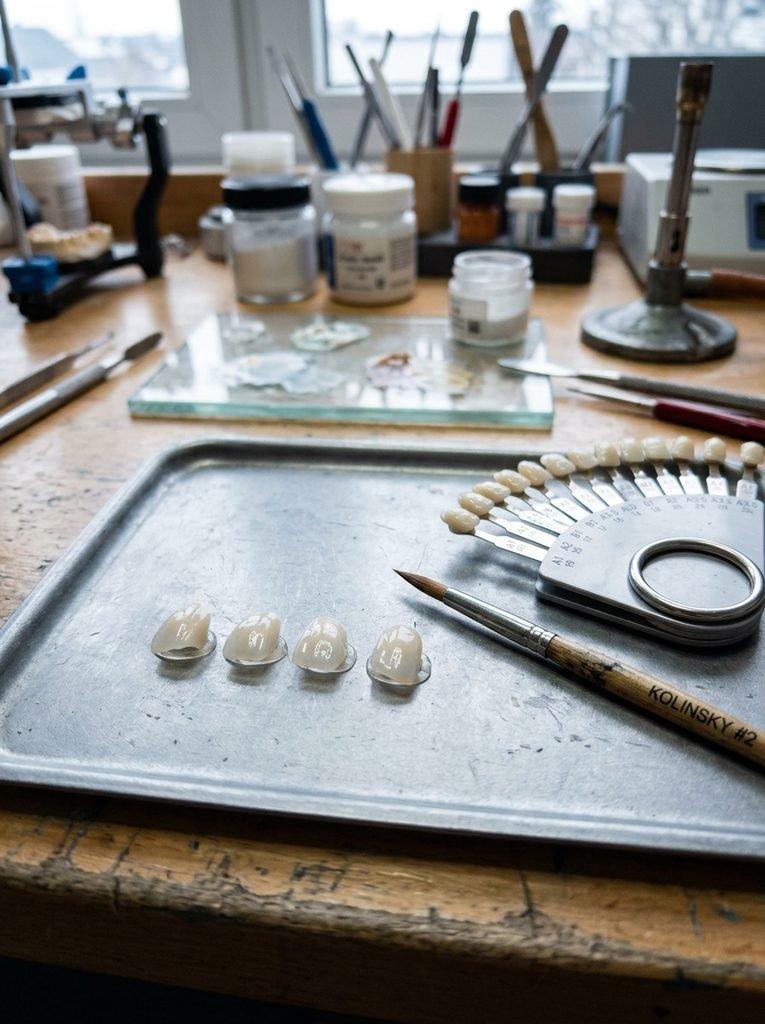
The second is what those teeth are being restored with. Ceramic restorations are individually designed and fabricated by a technician working from your impressions or scans, then fitted and adjusted by hand. Composite resin is sculpted directly onto the tooth in a single visit with no laboratory involved. That single distinction can halve or double a plan.
The third is what condition the mouth is in before cosmetic work begins. Inflamed gums, active decay, an old failing crown, a tooth that has drifted into a gap left years ago — each of these must be addressed first, and each is billed as its own treatment. Two patients quoted for “eight veneers” can receive plans several thousand dollars apart purely because one arrived with a healthy foundation and the other did not.
The fourth is the clinician’s training and the laboratory they work with. Cosmetic dentistry is unusually technique-sensitive. The same ceramic, in two different pairs of hands, produces visibly different outcomes in translucency, edge shape and how the smile sits against the lip line. Experience is priced accordingly, and in this particular field the correlation between price and result is stronger than in most of dentistry.
What Does Each Procedure Cost On Its Own
Veneers, Bonding And Whitening
Porcelain and lithium disilicate veneers are the backbone of most cosmetic plans, generally costing $900 to $2,500 per tooth in higher-cost markets. Minimal-preparation and ultra-thin ceramic options usually fall in a similar band, sometimes slightly below it. Composite veneers, built up directly on the tooth, typically run $250 to $1,000 per tooth.
Direct composite bonding, used for a chipped edge, a small gap or a worn corner, is the least expensive meaningful intervention available, at roughly $250 to $600 per tooth or surface. For a patient whose complaint is limited to two teeth, it is frequently the correct answer rather than the cheap one.
Professional in-clinic whitening usually costs $250 to $1,000, with dentist-supplied home trays somewhat less. Whitening is almost always sequenced first, because the shade your natural teeth reach becomes the target colour the laboratory matches your ceramics to. Reverse that order and you finish with restorations that no longer belong to the teeth beside them.

Crowns, Implants And Restorative Work
A crown generally costs $700 to $2,500 depending on material and location in the mouth. Crowns enter cosmetic plans when a tooth has too little healthy structure left to support a veneer, which is a clinical judgement rather than a preference.
Implants are the heaviest single item in any plan involving a missing tooth. A complete single implant, meaning the fixture placed in the bone, the connecting abutment and the final crown, commonly totals $3,000 to $6,000 in higher-cost markets. Full-arch fixed solutions supported by four to six implants generally run $15,000 to $35,000 per arch.
Read implant quotes carefully, because this is where advertised pricing misleads most often. A headline figure well below the ranges above is usually pricing the surgical placement alone, with the abutment and crown invoiced later. Preparatory surgery such as bone grafting or a sinus lift adds meaningfully again, typically several hundred to several thousand dollars depending on how much is needed.
Alignment And Gum Shaping
Clear aligner treatment used to straighten teeth before restorations are placed generally adds $2,500 to $8,000, depending on how far the teeth have to travel and how long the case runs.
Gum contouring, where an uneven or low gum line is reshaped so the teeth are properly framed, is usually priced per tooth or per section and commonly falls between $200 and $600 per tooth, with larger reshaping cases running higher. It is a small line item that has an outsized effect on whether a finished smile looks designed or merely repaired.
How Much Does A Full Mouth Smile Makeover Cost
Most people do not need every tooth treated. The smile zone, meaning the teeth genuinely visible when you talk and laugh, is usually six to ten upper teeth and sometimes a few lower ones. Restoring that zone in ceramic typically totals $12,000 to $28,000, and for the large majority of patients it delivers the full visual result without touching the back teeth at all.
Genuine full-mouth treatment, covering sixteen to twenty-eight teeth across both arches, is a different category of undertaking. It usually costs $25,000 to $60,000 and is driven by function as much as appearance: severe wear from grinding, a bite that has collapsed over decades, or widespread failure of old restorations placed in an earlier generation of dentistry.
If a plan for an otherwise healthy mouth leaps straight to twenty teeth, ask for the reasoning. It may well be sound. It should still be explained to you in terms of what each tooth needs, not offered as the default package.
What Is Missing From The Price You Were Quoted
This is the section that decides whether your budget survives contact with reality, and it is the one most cost pages skip.
The consultation itself is usually charged, often $50 to $300, and diagnostic records can be separate again: photographs, scans, X-rays and in some cases a digital design or a physical mock-up you wear for a few days to test the shape before anything permanent happens. That preview stage is genuinely valuable and it is genuinely an extra cost.
Temporary restorations sit in a similar grey zone. You wear provisional veneers or crowns while the laboratory builds the final ones, and whether those are inside the headline figure varies from clinic to clinic.
Then comes the aftercare hardware, which is where most people are caught off guard. A custom night guard, protecting new ceramic work from grinding forces, generally costs $250 to $700 and is not optional for anyone who clenches. Aligner cases end with retainers, frequently quoted separately at the very end of treatment. Follow-up adjustment visits in the weeks after fitting may or may not be included.
Does The Order Of Treatment Change What You Pay
It changes both the price and how much of your own tooth survives the process, which makes it the most consequential decision in the whole plan.
Consider mildly crowded front teeth. One route places ceramic straight onto them, using the thickness of the restoration to disguise the misalignment. That requires cutting deeper into the tooth, because the ceramic has to have somewhere to sit without leaving the smile looking bulky. The other route straightens the teeth first over a few months, then restores them with far thinner ceramic on a surface that is already in the right position.
The second route costs more this year and less over a lifetime. Less enamel is removed, the underlying teeth stay stronger, the restorations are less likely to fail early, and the result reads as natural rather than applied.
The same logic governs gum work. Reshaping an uneven gum line before the laboratory builds your restorations means the technician is designing to a finished frame. Doing it afterwards means altering the setting of a picture that has already been hung.
A plan that opens with restorations on visibly rotated teeth, with no discussion of alignment at all, deserves a second opinion. Not because it is necessarily wrong, but because the reasoning should exist and you should hear it.
Does Insurance Cover A Smile Makeover
Dental insurance and public health systems are built around function and disease, not appearance. Treatment chosen to make teeth look better is classified as elective and excluded, and that classification is remarkably consistent across markets.
Function is the exception, and it is worth pursuing properly. A crown on a fractured or heavily decayed tooth, gum disease treatment, an extraction, an implant replacing a tooth you actually lost, orthodontics with a documented functional justification — these are restorative and frequently attract partial coverage. The problem is that they usually arrive bundled inside a plan labelled cosmetic, and once labelled that way they are declined as a block.
The practical move is administrative rather than clinical. Ask the practice to split the treatment plan into two clearly separated sections, cosmetic and restorative, before anything is submitted anywhere. You cannot claim for what has not been itemised, and no insurer will do the separating on your behalf.
Also check annual limits, which catch people out even when coverage does exist. Many plans cap total yearly payouts at a level that a single restorative visit exhausts on its own.
How Much Does A Smile Makeover Cost In Different Parts Of The World
Price differences across countries are dramatic and mostly reflect operating costs rather than material quality, since the major ceramics, implant systems and bonding agents are manufactured by the same global suppliers and shipped everywhere.
The highest-cost tier covers North America, Australia, New Zealand, Switzerland, the Nordic countries and premium private clinics in the Gulf. Ceramic restorations here commonly sit at $1,000 to $2,500 per tooth, and a smile zone plan of eight teeth rarely finishes below $12,000.
A middle tier covers much of Western Europe, the United Kingdom, Japan, South Korea and Singapore. Expect broadly 20 to 40 per cent below the top tier for comparable work, with capital cities pricing well above regional practices in the same country.
A lower-cost tier includes Southern and Eastern Europe, Turkey, Mexico, parts of Latin America, Southeast Asia, India and South Africa. Ceramic work here often costs 50 to 80 per cent less than in the highest tier, and this gap is what created the dental travel industry in the first place.
One caution applies globally: within any country, the spread between the cheapest and most expensive quote for identical treatment is routinely two to four times. Comparing your quote against a national average tells you far less than comparing it against two other written quotes from your own city.
Is It Cheaper To Travel Abroad For A Smile Makeover
The savings are real and they are not a trick. A clinic in a lower-cost economy pays less for premises, staff and laboratory work, and it passes some of that on. Plenty of excellent dentistry is performed on travelling patients every week.
The risk is not the country. It is substitution, and it is worth understanding precisely because it is invisible until years later. A veneer is a thin facing bonded to the front of a tooth after a modest amount of enamel is removed. A crown covers the tooth entirely, which requires reducing it to a much smaller core first. Crowns are faster to fit, more forgiving of imperfect preparation, and easier to deliver on a compressed one-week schedule. A patient who agreed to veneers and returned home with crowns has permanently lost the majority of their natural tooth structure across every treated tooth, and no future dentistry can give it back.
The second risk is distance from aftercare. Ceramic work needs adjustment, and occasionally something debonds or a bite feels wrong three months later. If the treating clinic is a flight away, that becomes an expensive inconvenience at best.
If you travel, insist on three things in writing before you fly: your diagnostic records reviewed and a written plan issued in advance, the exact procedure named for each individual tooth, and a stated warranty with a defined process for handling problems. Then arrange a dentist at home who is willing to manage aftercare, and confirm that before booking rather than after.
What Will This Smile Cost You Over Twenty Years
The cheapest option today and the cheapest option over a working lifetime are frequently not the same thing, and almost nobody runs this calculation before deciding.
Composite work generally needs refreshing, repolishing or replacing every five to eight years. It stains gradually, chips at the edges, and loses its surface lustre. Well-made ceramic restorations commonly last ten to twenty years, resist staining, and hold their surface finish.
Put money against those lifespans. Ten composite restorations at a modest per-tooth price, replaced twice across two decades, can quietly overtake the total cost of ten ceramic restorations placed once. The upfront invoice ranks them one way and the twenty-year invoice ranks them the other.
None of which makes composite wrong. It is the right choice for a small localised repair, for a patient who wants something reversible, for anyone testing a new tooth shape before committing, and for anyone whose priority is a bill that is survivable this year rather than optimal by 2046. Those are legitimate reasons. The point is simply to make the comparison with both numbers visible.
Whichever route you take, budget for maintenance. Whitening fades and needs topping up, bonding needs occasional repolishing, night guards wear out, and a smile makeover realistically carries a few hundred dollars a year in upkeep for the rest of its life.
How Do People Actually Pay For It
Financing does not reduce what the treatment costs. It changes when you pay, and sometimes it quietly increases the total.
In-clinic payment plans are the simplest option and often the best value, typically spreading the balance over six to eighteen months at no interest. Third-party health finance products are widely available and usually offer a promotional interest-free window. The clause to check before signing is what happens if the balance is not cleared inside that window, because some products then apply interest retroactively across the entire original amount rather than the remaining balance. That single condition is the most expensive piece of small print in cosmetic dentistry.
Longer finance terms lower the monthly figure and raise the total substantially. General personal loans vary enormously by country and credit profile and should be compared against the clinic’s own offer rather than assumed to be worse.
There are also routes that involve no borrowing at all. Dental teaching hospitals in most countries offer supervised treatment at a significant discount, performed by qualified trainees under experienced supervision, with longer appointments and longer waiting lists as the trade. Phasing is the other underused option: whitening and bonding this year, ceramic work next year, implants the year after. It costs nothing extra beyond an additional consultation, and it lets you live with each stage before committing to the next.
Before signing any finance agreement, ask a single question and get the answer in writing: what is the total amount I will have paid by the end of the term, not the monthly instalment.
How Do You Tell A Fair Quote From A Bad One
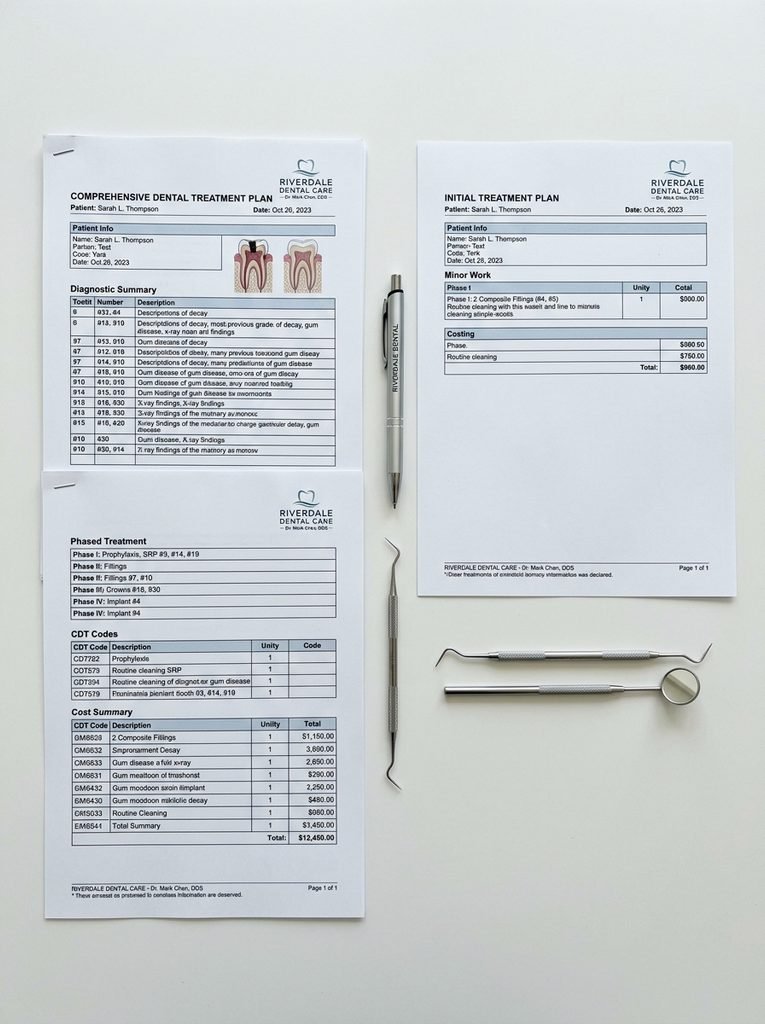
A fair quote is itemised, sequenced and capable of explaining itself. Four things should be visible on the document in front of you: exactly which teeth are being treated and how, what preparatory work has to happen before cosmetic treatment begins, which materials and which laboratory will be used, and an all-in total that includes records, temporaries and follow-up visits.
Three warning signs are worth naming plainly.
The first is a plan that treats considerably more teeth than your complaint requires, with symmetry offered as the only justification. Symmetry is a real clinical consideration and it is sometimes the honest answer, but it should be argued rather than assumed.
The second is cosmetic treatment planned without diagnostic imaging. Nerve position, bone level and hidden decay cannot be assessed by looking at a smile, and any plan built without that information is being built on guesswork.
The third is a consultation that never once uses the word no. A clinician who declines something you asked for, and explains why your enamel or your gums or your bite will not support it, is showing you their judgement. That is the thing you are actually paying for.
Verify registration through your country’s dental regulator, which every market maintains and most publish as a searchable public register. Then get two or three written plans, because on a like-for-like basis the spread between them is usually far wider than anyone expects, and comparing them is the highest-return hour you will spend on this entire decision.
Key Takeaways
- Smile makeover cost in 2026 spans roughly $1,000 to $50,000, because the term covers a single-afternoon refresh and a multi-stage rebuild with equal accuracy.
- Tooth count, material, existing oral health and clinician experience explain most of the variation. Location stacks on top of all four.
- The headline quote often excludes records, temporaries, adjustments and the night guard. Ask for the itemised version instead.
- Treatment sequence changes both the price and how much natural tooth survives. Straightening before restoring usually means far more conservative preparation.
- Purely cosmetic work is essentially never covered anywhere. Split the plan into cosmetic and restorative sections so the restorative part can be claimed.
- Composite costs less today and frequently more across twenty years once replacement cycles are counted.
- Travelling abroad saves genuine money, but the failure mode is crowns delivered in place of veneers. Get the exact procedure named per tooth in writing.
Smile Makeover Cost At A Glance, 2026
| Plan Type | Teeth Treated | Typical Cost (USD) | Typical Cost In Lower-Cost Markets |
|---|---|---|---|
| Whitening plus light bonding | 2–4 | $1,000 – $4,000 | $400 – $1,500 |
| Bonding or ceramic on front teeth only | 4–6 | $5,000 – $15,000 | $1,500 – $5,000 |
| Six ceramic restorations plus whitening | 6 | $8,000 – $18,000 | $2,500 – $6,000 |
| Full upper smile zone in ceramic | 8–10 | $12,000 – $28,000 | $3,500 – $9,000 |
| Full mouth, both arches | 16–28 | $25,000 – $60,000 | $8,000 – $20,000 |
| Plan including implants or bite reconstruction | varies | $30,000 – $70,000+ | $10,000 – $30,000+ |
Your Next Five Steps
- Photograph your smile in daylight, relaxed and smiling, then write down in ordinary words what you want changed. Colour, shape, gaps and alignment are four separate problems carrying four separate price tags, and most people are chasing only one of them.
- Book two consultations at practices that publish their own case photography, and ask each for a written itemised plan rather than a verbal range.
- Ask both to separate the plan into cosmetic and restorative sections, then submit the restorative portion to your insurer or health scheme before committing to anything.
- Price the twenty-year version of each material option, not just the invoice in front of you. Multiply the cheaper material by the number of replacement cycles it will realistically need.
- If you are financing, get the total repayable across the full term in writing, and confirm exactly what happens if a promotional interest-free period ends with a balance outstanding.
FAQ
How Long Does A Full Smile Makeover Take From Start To Finish?
A ceramic case usually runs six to twelve weeks, moving through consultation and records, design and mock-up, preparation with temporaries, then final fitting and adjustment. Whitening and bonding can be completed in one or two visits. Plans involving implants take far longer, because the fixture needs several months to integrate with the bone before the final restoration can be attached.
Can I Have A Smile Makeover If My Gums Are Not Healthy?
Not until the gums are treated first. Restorations bonded to an inflamed foundation fail early, and gum recession afterwards exposes the margins of the work, which shows as a dark line at the gum edge. Periodontal treatment is a separate stage with its own cost, and it is one of the main reasons quoted totals rise after a proper examination.