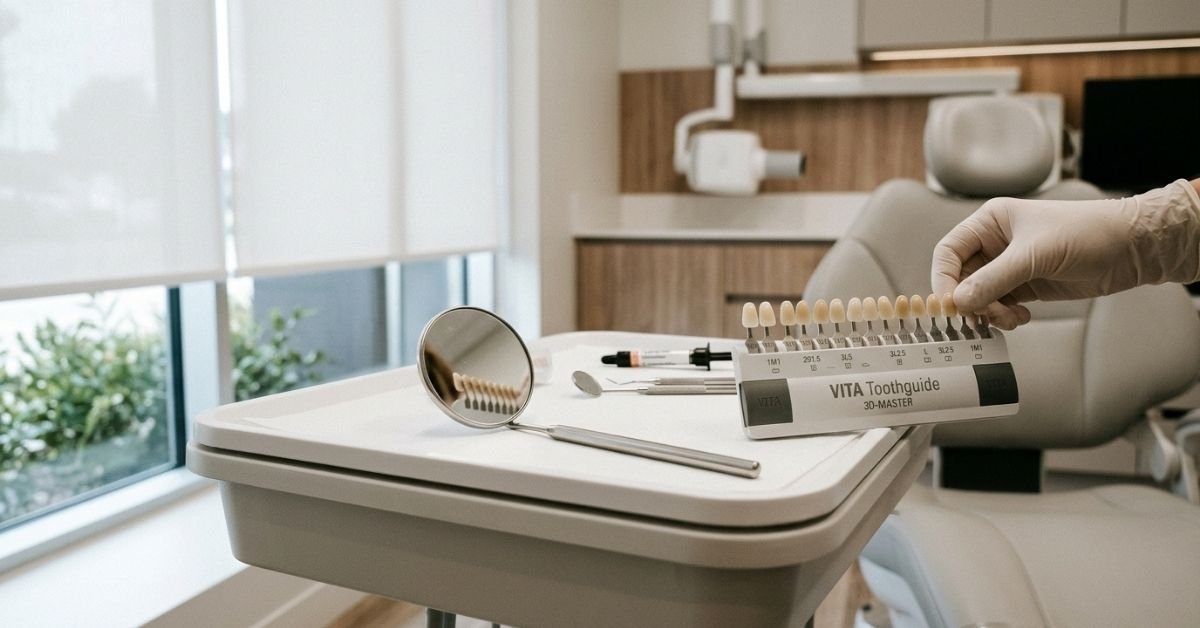
Veneers vs Composite Bonding: Cost Per Tooth Breakdown
Two people can walk into the same clinic with the same chipped front tooth and leave with bills that differ by a factor of ten. Nothing about their mouths explains the gap. The material does.
That is the whole of the veneers vs composite bonding question, stripped of marketing. One treatment is sculpted by hand in a single sitting. The other is manufactured to order by a technician and cemented on weeks later. Everything that follows the price, the lifespan, the reversibility, the maintenance flows from that single structural difference.
Most cost articles quote a range and leave you there. This one keeps going, because the range is only half the sum. What matters is what each option costs you per year of wear, and what sits outside the quoted figure.
Quick answer: Composite bonding usually costs the equivalent of $250–$600 per tooth and lasts roughly five years. Porcelain veneers usually cost $900–$2,500 per tooth in higher-income markets and last ten to fifteen years. Once divided across their working life, the two converge which is why durability and enamel loss matter more than price.
What Each Treatment Actually Is
Composite bonding uses a soft, tooth-coloured resin that the dentist places directly onto the tooth, shapes freehand, hardens with a curing lamp, then smooths and polishes. There is no laboratory, no waiting, no temporaries. A narrow gap can be closed, a broken edge rebuilt, or a short tooth lengthened inside half an hour. When the resin is layered across the full front surface of several teeth to redesign the shape and shade, clinics often sell it as composite veneers the same resin, a bigger job, and a higher composite veneers price.
Porcelain veneers are thin ceramic facings made individually for each tooth. The dentist reduces the tooth surface slightly, records the shape digitally or with an impression, fits temporary covers, and sends the case to a laboratory. A technician builds, fires and glazes each shell, and two or three weeks later the finished units are bonded permanently in place. Fired porcelain does not absorb stain the way resin does, and it holds its surface polish for years.
The trade-off sits in that word reduces. Conventional veneer preparation removes a fraction of a millimetre of enamel from the face and edge of the tooth to make room for the ceramic. Enamel is not living tissue and it does not regrow. From the day it is removed, that tooth needs to stay covered if a veneer fails a decade later, you replace it, you do not simply go back to how things were.
Bonding rarely demands that. In many straightforward cases the resin is added to an untouched tooth and can later be polished away, leaving the tooth broadly as nature left it. That reversibility is the quiet advantage people undervalue when they are comparing prices alone.

Why The Price Gap Exists
Unpack a veneer quote and it stops looking arbitrary.
A bonding appointment costs the practice chair time and a small quantity of resin. There is no third party to pay. The fee is effectively a charge for the clinician’s eye, hand and time — nothing else leaves the building.
A veneer case consumes chair time twice over, plus a laboratory invoice that typically runs $100–$400 per unit depending on the ceramist’s skill and location, plus temporary covers, plus impression or scanning costs, plus the standing risk that a unit returns needing adjustment or remaking. Highly regarded ceramists working on full smile designs charge multiples of that, and those invoices pass directly to the patient.
There is also a skill premium that cuts across both materials. Freehand composite artistry is genuinely difficult, and dentists known internationally for it charge accordingly. A superb composite case in a major city can easily cost more than an average porcelain case elsewhere. Price signals reputation at least as much as it signals material.
Veneers vs Composite Bonding: The Cost Per Tooth Numbers
Dental pricing is not global in the way electronics pricing is. The same porcelain unit can cost eight times more in one country than another, driven by labour costs, laboratory wages, clinic overheads, regulation and local purchasing power. The tiers below are broad planning ranges expressed in USD equivalents.
| Market tier | Typical examples | Composite bonding per tooth | Porcelain veneer per tooth |
|---|---|---|---|
| Higher-cost markets | North America, Western and Northern Europe, Australia, Singapore, Gulf states | $250–$600 | $900–$2,500 |
| Mid-cost markets | Southern and Central Europe, parts of East Asia, Türkiye, Malaysia, Brazil | $100–$300 | $350–$900 |
| Lower-cost markets | South Asia, parts of Africa, Southeast Asia, Egypt, Mexico | $40–$150 | $120–$450 |
| Premium tier, any market | Reputation-led cosmetic practices anywhere | $600–$1,200 | $2,500–$4,000+ |
Two things follow from that table. First, a reader in a lower-cost market may find porcelain affordable where a reader in a higher-cost market finds only bonding realistic the same decision produces opposite answers. Second, the premium tier exists everywhere, which is why “veneers cost X in my country” is never quite true.
Scaling to a full smile. Almost nobody treats a single tooth. The upper front six the teeth visible in an ordinary smile is the most common package, with eight or ten units chosen when the smile is wide.
| Teeth treated | Composite bonding, higher-cost market | Porcelain veneers, higher-cost market | Porcelain veneers, lower-cost market |
|---|---|---|---|
| 2 | $700–$1,200 | $1,800–$5,000 | $240–$900 |
| 4 | $1,400–$2,400 | $3,600–$10,000 | $480–$1,800 |
| 6 | $2,100–$3,600 | $5,400–$15,000 | $720–$2,700 |
| 8 | $2,800–$4,800 | $7,200–$20,000 | $960–$3,600 |
| 10 | $3,500–$6,000 | $9,000–$25,000 | $1,200–$4,500 |
So, is composite bonding cheaper than veneers At the point of payment, yes, almost everywhere and by a wide margin. On a six-tooth case in a higher-cost market the difference is commonly $3,000 to $11,000. That single figure is what most people are really weighing.
What The Quote Includes And What Gets Billed Separately
This is the part that clinic pages tend to leave vague, and where budgets quietly break.
| Line item | Usually included? | Typical additional cost |
|---|---|---|
| Consultation and clinical photographs | Sometimes free or credited | $0–$200 |
| Radiographs and digital scans | Frequently separate | $50–$200 |
| Digital design preview or wax mock-up | Rarely included | $150–$700 |
| Temporary covers during laboratory work | Usually included with porcelain | $0–$120 per tooth |
| Whitening before treatment | Almost never included | $150–$500 |
| Gum reshaping | Separate procedure | $150–$450 per tooth |
| Protective night appliance | Almost never included, often essential | $200–$700 |
| Ongoing polishing appointments | Not included | $60–$200 per visit |
| Replacement after failure | Not included | Full unit price again |
Two of those deserve underlining.
Whitening comes first, always. Neither resin nor ceramic responds to bleaching gel. Whatever shade your natural teeth are on treatment day becomes the permanent reference point, because your new work is colour-matched to the teeth beside it. Whiten afterwards and you create a visible mismatch you cannot correct without redoing the work. Whitening is therefore a prerequisite cost, not an optional upgrade.
The night appliance is not an accessory. Grinding and clenching are the leading causes of early failure in both materials. Declining a $400 guard to protect $8,000 of ceramic is a false economy that clinics see play out constantly.
The Real Breakdown: Cost Per Year Of Service
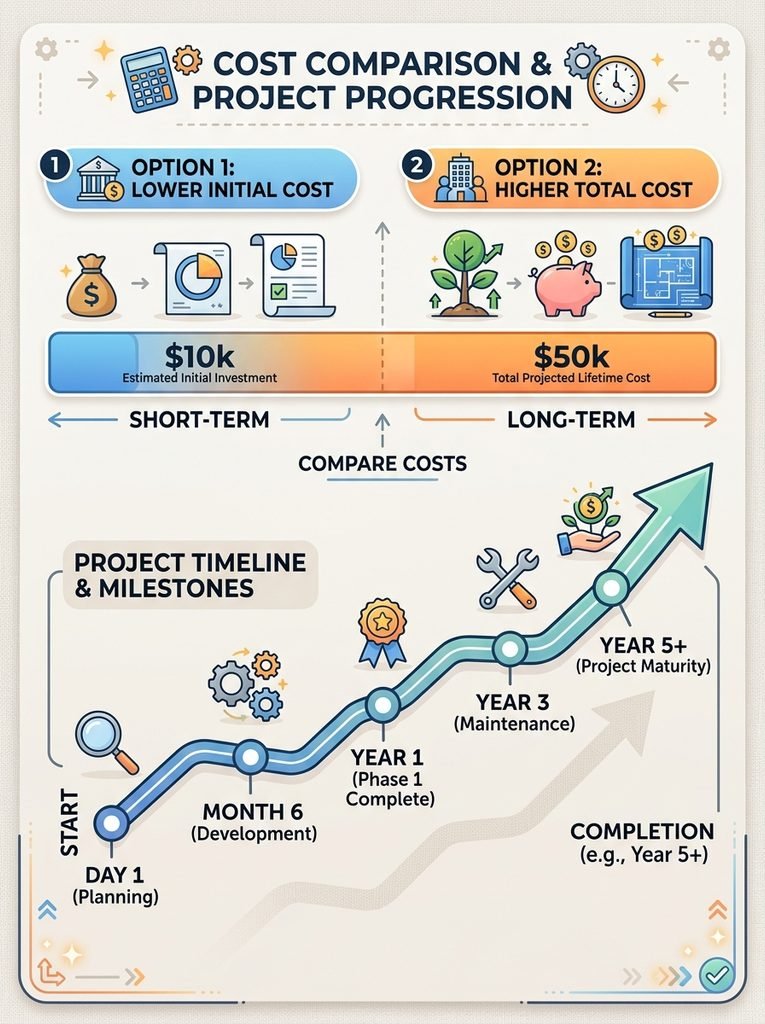
The sticker price answers what you pay today. Cost per year answers what the treatment actually costs you. Using mid-range higher-cost-market figures for a six-tooth case:
| Composite bonding | Porcelain veneers | |
|---|---|---|
| Cost for six teeth | $2,800 | $8,400 |
| Realistic lifespan | 4–7 years | 10–15 years |
| Planning figure used | 5 years | 12 years |
| Cost per year | $560 | $700 |
| Cost per tooth per year | $93 | $58 |
| Polishing and upkeep | Every 12–18 months | Seldom needed |
| Stain resistance | Moderate, declines with age | Very high, stable |
| Repairable in the chair? | Yes, quickly and cheaply | Usually replaced, not repaired |
Across a five-year horizon, bonding wins outright less money spent, and the option to change course later without consequence. Across twenty years, bonding requires three or four replacement rounds while porcelain requires one or two, and the ceramic route pulls level or moves ahead on total spend.
On dental bonding vs veneers durability, the day-to-day behaviour of the materials matters as much as the numbers. Composite resin is softer and slightly porous. Coffee, tea, wine, spiced foods and tobacco discolour it gradually, and unlike natural enamel it cannot be bleached back. Small chips along the biting edge are common after a few years. The compensating advantage is that both problems are cheap and fast to correct a polish or a patch, often in a single short visit.
Porcelain resists staining almost indefinitely and keeps its gloss for a decade or more. But its failures are binary. A crack, a fracture or a debond usually means a new unit at full price, with the laboratory bill repeated.
Where People Overspend And Regret It
Treating more teeth than show. Packages of ten or twelve units are sold routinely where six would be invisible from anything but centimetres away. Each extra tooth is another full-price unit and, with porcelain, another healthy tooth committed permanently to being covered. Smile at a mirror the way you smile at people, and count only what genuinely appears.
Reaching for porcelain to fix a bonding problem. A single chipped corner, a small gap between two teeth, one slightly short incisor these are textbook bonding cases. Preparing a sound tooth for ceramic to correct a two-millimetre flaw is an irreversible answer to a reversible question.
Reaching for bonding to fix a porcelain problem. The opposite mistake costs just as much in the end. Deeply discoloured teeth, severe internal staining, heavily worn edges, or cases needing a substantial change in tooth shape will strain composite badly. Resin is semi-translucent, so a dark tooth underneath shows through unless the layer is built up thickly, and thick composite chips. Some cases genuinely require ceramic, and being talked out of it to save money leads to paying twice.
Choosing purely on price, especially across borders. Travelling for treatment can cut costs legitimately and many clinics abroad produce excellent work. The risk is almost never the treatment itself it is the aftercare. A debond in month nine becomes a flight, accommodation and time off work, or a local dentist charging full fee to fix someone else’s case. Price the failure scenario alongside the success one before booking anything.
A note on insurance and public schemes: purely cosmetic work is excluded almost everywhere in the world, whether the system is insurance-based or state-funded. Bonding occasionally attracts partial cover when it genuinely restores a fractured or decayed tooth rather than improving appearance. It is worth asking. It is not worth planning around.
Planning the Long Game
Choosing bonding Set aside roughly a fifth of the original cost each year and the replacement round funds itself when it arrives. Book a polish every twelve to eighteen months, and be realistic about staining habits — the first two years of daily coffee do more visible damage to resin than years six through ten do to porcelain.
Choosing porcelain? Understand that the enamel decision is made once, permanently, on preparation day. Budget for at least one replacement cycle in your lifetime, and more if you are treating in your twenties or thirties. Wear the protective appliance.
There is also a middle path that clinics rarely propose unless asked: ceramic on the two or four teeth that genuinely need structural change, composite on the rest. It reduces the total meaningfully, preserves enamel where preservation is still possible, and often produces a more natural result than a uniform row of identical units. It takes more planning, which is precisely why it is under-offered.
One final piece of practical advice that applies in every market: insist on seeing a design preview before you commit. Paying a modest fee to view a simulation of your own face with the proposed result is the cheapest protection in this entire process. Approving a shape you have actually seen eliminates the single most common source of disappointment.
Who Should Act Now And Who Should Wait
Proceed with composite bonding if the corrections you want are modest, your budget is limited, you want the result completed in one visit, you are not yet certain enough to give up enamel permanently, or you want to live with a new smile shape before committing to ceramic.
Proceed with porcelain veneers if your teeth are significantly discoloured or worn, enamel has already been lost to erosion or grinding, you have tried composite and outgrown it, you want a decade of stability with minimal upkeep, and the full budget genuinely exists rather than being financed uncomfortably.
Wait if you grind and have not been assessed for it, you have active decay or inflamed gums, you are in orthodontic treatment or considering aligners, you have not seen a design preview, or the financing would cost more in interest than the treatment costs outright. None of those is a reason to abandon the idea. Each is a reason to delay by a few months and treating around any of them almost always costs more than pausing would have.
Key Takeaways
- Composite bonding typically costs $250–$600 per tooth in higher-cost markets and far less elsewhere; porcelain veneers typically cost $900–$2,500 per tooth in the same markets.
- Prices vary by a factor of five or more between countries, so market tier matters more than any single national average.
- On a six-tooth case, the upfront difference is commonly $3,000–$11,000 in higher-cost markets.
- Divided by service life, the gap narrows sharply: around $93 per tooth per year for bonding versus $58 for porcelain.
- Bonding is usually reversible and always repairable. Porcelain requires permanent enamel removal and is replaced rather than mended.
- Consultations, scans, previews, whitening and protective appliances usually sit outside the quoted per-tooth price.
- Whitening must happen before treatment neither material can be bleached afterwards.
- A mixed case, ceramic on some teeth and composite on others, is frequently the best value and is rarely offered unless you request it.
- All figures here are planning ranges. Confirm actual costs with a licensed clinician in your own country.
Frequently asked questions
Can composite bonding be reversed later?
Usually yes. Because the resin is added to the tooth rather than cut into it, a dentist can polish it away and return the tooth close to its original condition. This holds only where little or no enamel was removed during placement, so ask your clinician directly whether your specific case involves any preparation before you agree to it.
Do either of these treatments harm the tooth underneath?
Neither harms a healthy tooth when placed correctly, but conventional porcelain veneers require permanent removal of a thin enamel layer that cannot regenerate. That tooth then requires covering for life. Bonding generally needs no removal at all. Decay can still start at the margins of either if daily cleaning is neglected.