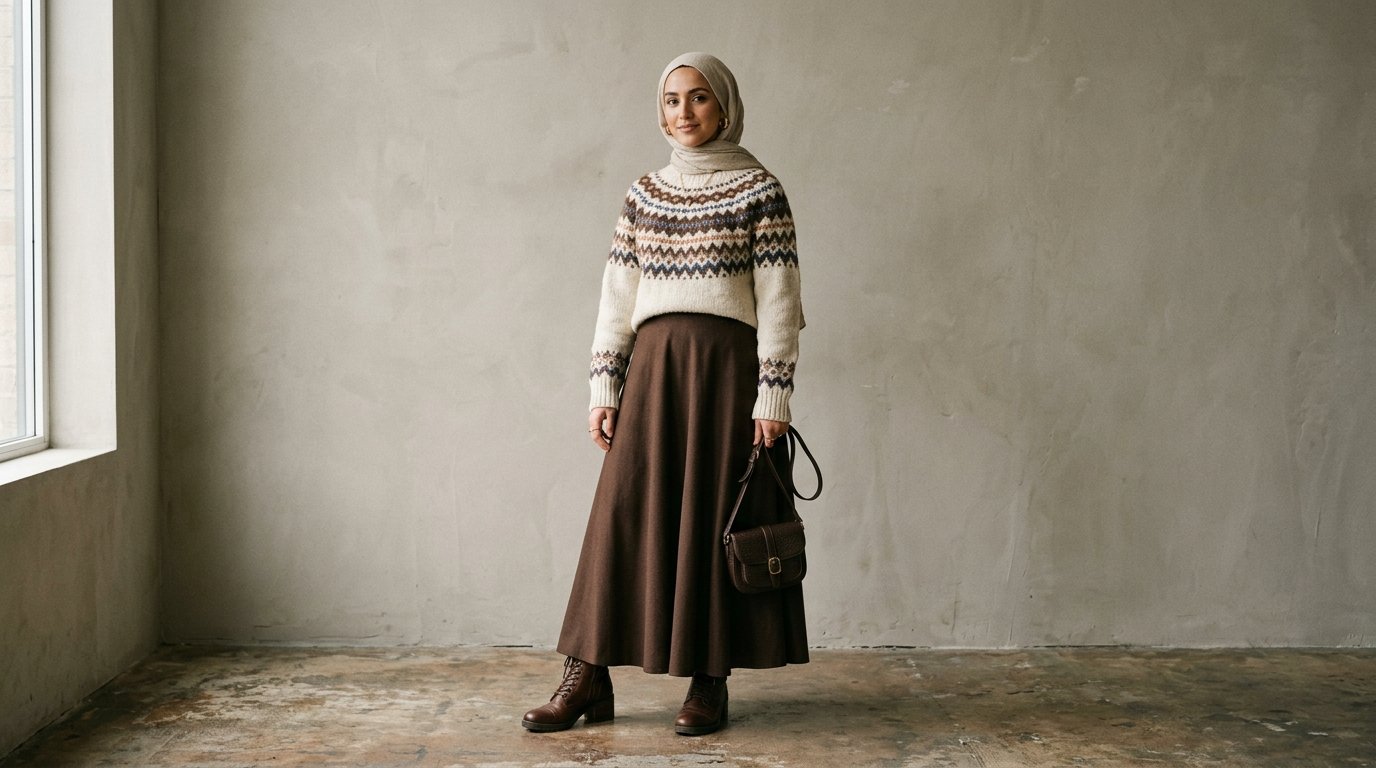
Fall 2026’s Knitwear Is Designed for Bare Shoulders and Big Volume — Here’s the Proportion Rule That Makes It Work Covered
Sweater season starts the week the coat guides stop being theoretical, and this year it arrives with a problem. Fall 2026’s knitwear is built around two ideas — volume up top, and knit that shows skin — and both of them assume a body the reader of this site is not styling.
The short version: Fall 2026 knitwear returns to heritage — Fair Isle, considered construction, precision over excess. Runways pushed broad, puffy shoulders and boxy silhouettes, plus cutout and mesh knits. For modest sweater outfits 2026, that means one loose piece per outfit, fine-gauge bases under chunky layers, and cutouts styled over a covered foundation.
That is the whole method. Below is how each trend actually behaves once your hem reaches your ankle and your neckline is already handled.
Why This Season Is Harder Than Last Season
Last autumn’s oversized-everything moment was generous to covered dressing. Volume was the point, and volume is what a modest wardrobe already has.
This year is different in a specific way. Fall/Winter 2026 runways were about broad or puffy shoulders and taking up space — Tory Burch showed boxy knits with distinct shoulders layered over button-ups, and Carolina Herrera leaned toward a balloon silhouette. Volume moved upward, to the shoulder line.
For a covered silhouette, upper volume is the expensive kind. You are usually already wearing a scarf with its own mass around the head and neck, and a top layer that skims rather than clings. Add a shoulder that takes up space and you have three wide things stacked vertically, with nothing narrow anywhere to read against. The outfit does not look bad exactly. It looks like it has no edges.
The fix is not to avoid the trend. It is to spend the volume once.
The One Rule: Spend Your Volume Once
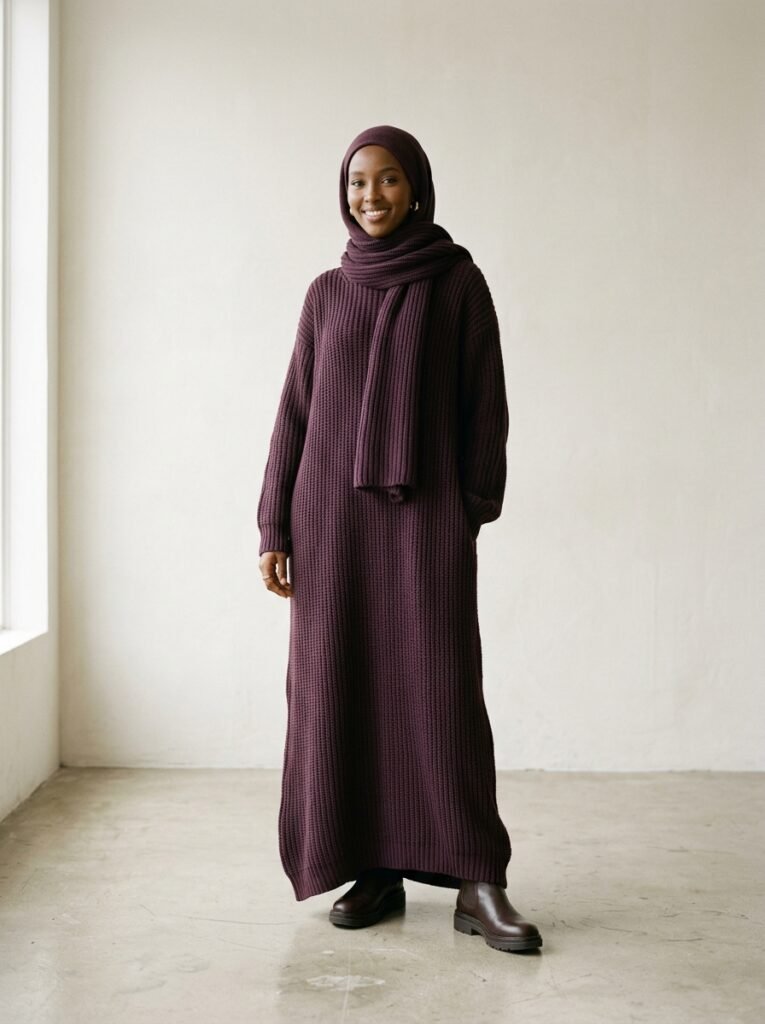
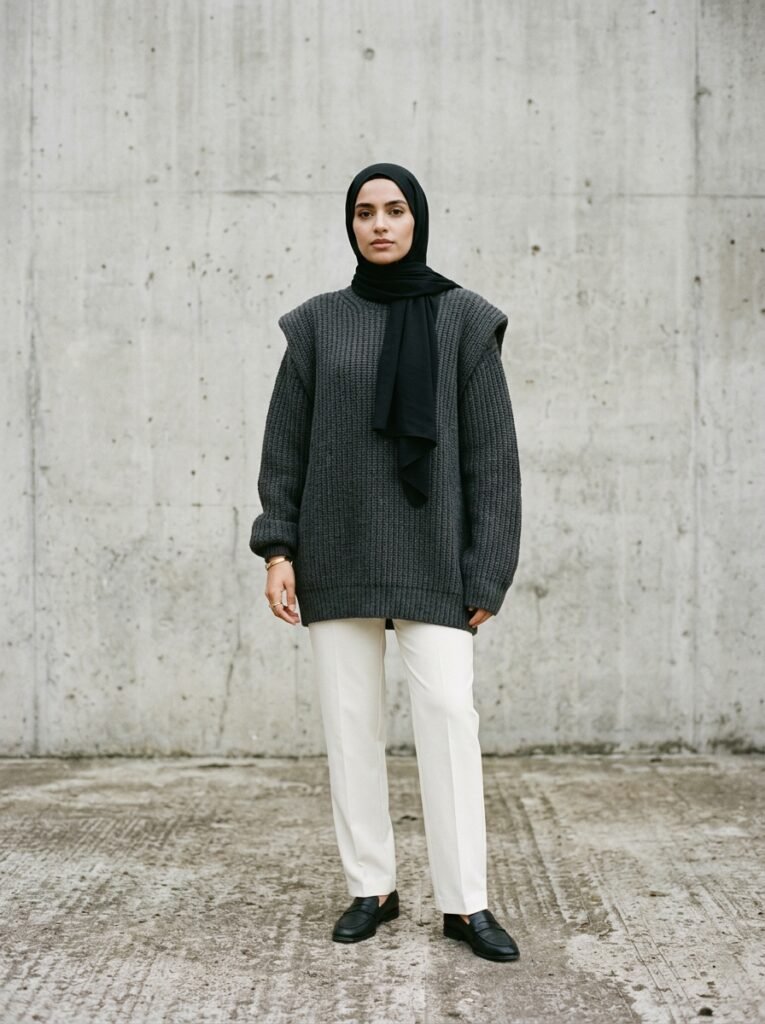
Pick the single piece in the outfit that gets to be big. Everything else gets deliberately narrow — not tight, narrow. Straight rather than wide. Fluid rather than full.
Mainstream stylists have arrived at the same principle from the opposite direction. The advice for fall 2026 layering is to create dimension without adding bulk: start with lightweight foundations like fitted turtlenecks, crisp button-downs or fine-gauge knits, then build with contrasting lengths and textures.
That is one of the rare times this season when the standard advice transfers directly. A fine-gauge base under a chunky layer is exactly the mechanism that keeps covered outfits from turning into padding. The base does not need to be fitted in the body-conscious sense — it needs to be thin. Gauge is doing the work, not fit.
Three combinations that hold:
- Big shoulder sweater + straight-leg trousers + flat, undraped hijab
- Chunky cardigan + narrow column dress or slim maxi skirt underneath
- Fine-gauge knit + voluminous wide-leg trouser, with all the volume below the waist
One that does not: chunky sweater + wide-leg trouser + heavily draped scarf. Three volumes, no reference point.
Fair Isle: The Season’s Easiest Win
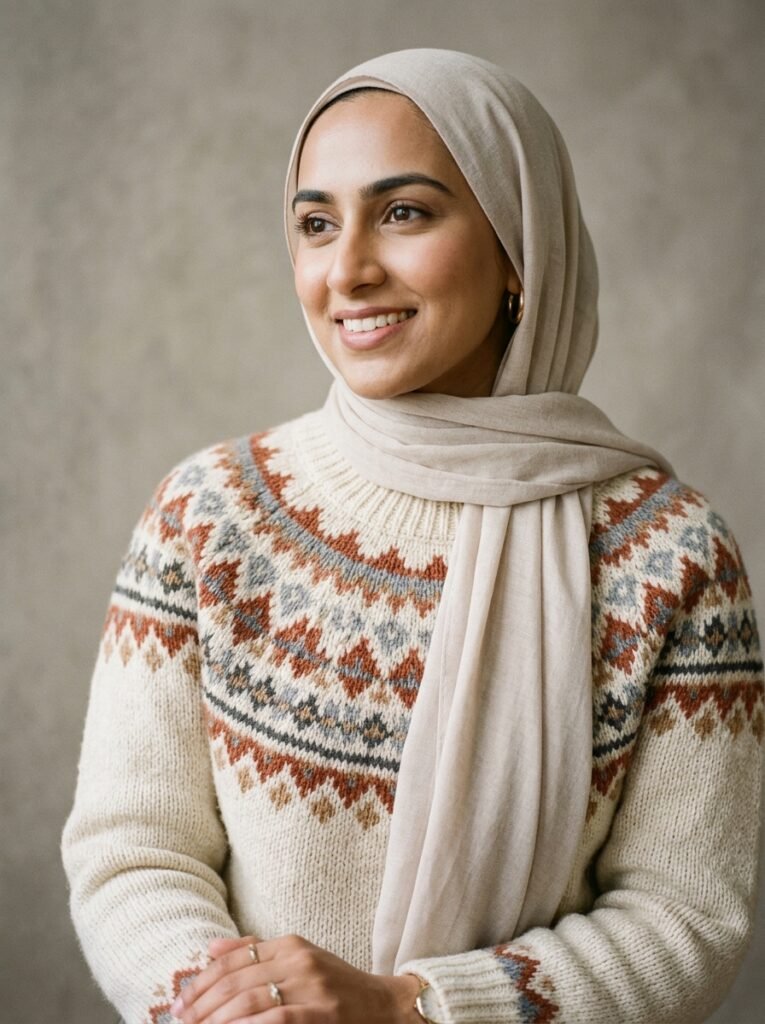
Fair Isle, the geometric multi-colour motif rooted in the Shetland knitting tradition, is simply everywhere this season. Designers approached it from every angle — Altuzarra showed classic sweater versions, Khaite sent out embellished knits that sparkled, and Brandon Maxwell offered a quieter take in soft neutrals.
This is the trend of the season that costs a modest wardrobe nothing. Fair Isle is a chest-and-yoke pattern. It lives exactly where a covered outfit still shows fabric, and it does its entire job without needing a hem, a waist or a tuck to be visible.
Styling-wise, it works layered under a sharp blazer as well as worn alone, and it reads freshest with pieces that temper its heritage roots — fluid wool trousers and loafers for the office, for instance.
The hijab decision nobody explains. A Fair Isle yoke has three to five colours in it. The instinct is to match your scarf to the brightest one. Do the opposite. Pull your hijab from the quietest colour in the pattern — the background cream, the muted oatmeal, the soft grey. The pattern stays the focal point, and your head does not become a second competing motif six inches above the first.
If the sweater’s neckline is a standard crew, this is also the easiest Fair Isle to wear covered: the pattern sits below the scarf line and stays fully visible.
Sweater Dresses and Knit Skirts
Knitwear this season is not only tops — sweater dresses arrived in various lengths and textures, and Proenza Schouler’s Fall/Winter 2026 runway showed long, slightly slouchy knit dresses that could be dressed up or down.
Long and slouchy is the phrase to shop by. A slouchy knit maxi is the single most efficient garment of this season for covered dressing, because the drape does the modesty work without a lining, a slip, or a second layer underneath.
Two things determine whether it works:
Weight. A knit dress that is too fine will cling through the hip and thigh regardless of how loose the cut looks on the hanger. Look for a dense, slightly heavy knit — the kind that has enough mass to fall straight down from the widest point rather than following the body. A thicker gauge is genuinely more forgiving here, not less.
What goes over it. Chunky scarves and wraps over knit dresses are part of the season’s knit-on-knit direction. Over a long knit dress, a chunky scarf is a good idea and a chunky cardigan usually is not — the dress already owns the softness, and a second soft layer erases the outline of both.
If a knit dress feels like too much commitment, a knit skirt with a fine-gauge top achieves the same texture story with the volume moved safely below the waist.
Knit-on-Knit, Without the Bulk
Layering one knitted garment over another — a cardigan over a tank, a pullover under a vest — without needing them to match is a strong cross-trend this season, and the point is contrast in texture rather than exact matching: a ribbed base under a cable-knit cardigan, or a fine knit under a chunky vest.
Texture contrast is the whole mechanism, and it is what saves this from becoming a bulk problem. Two knits of the same weight read as one thick shapeless mass. Two knits of clearly different gauges read as deliberate layering.
The covered version: a fine ribbed long-sleeve as the base, a chunky open cardigan or knit vest over it, and a bottom half that stays completely quiet. Do not add a coat to this combination until it is genuinely cold — the third layer is where knit-on-knit stops working.
Chloé and Prada showed a related idea, grounding sateen dresses and ruffled maxi skirts with woolly blazers, chunky knit scarves and deliberately mismatched materials — layering that reads a little undone in the best way. A silky maxi skirt under a wool knit is an unusually good formula for anyone whose wardrobe already runs long, because the fabric clash creates the interest that a visible waistline would normally provide.
The Trend to Adapt, Not Adopt
Knitwear this season also picked up the wider “naked dressing” direction — Schiaparelli showed a turtleneck sweater with mesh panels of varying sizes, and Diotima’s collection included knits with noticeable cutouts.
This one does not translate as shown, and there is no styling trick that makes an open cutout into a covered garment. But the texture idea is salvageable, and it is worth salvaging because it is one of the season’s most photographed looks.
Two workable routes:
Layer, don’t skip. A mesh-panel or open-stitch knit worn over an opaque fine-gauge long-sleeve keeps the visual — the light-and-dark stitch contrast, the depth — with none of the exposure. The under-layer should be a flat, matte solid in the same colour family so it reads as shadow rather than as a second garment.
Move the openwork to a closed shape. Open-stitch knitting on a cardigan worn closed, a knit scarf, or a loose-weave shawl gives you the same craft-forward texture in a form that does not depend on skin.
If neither appeals, skip it entirely. The most useful advice of the whole season is to pick one knitwear trend and commit to it fully rather than combining several — the restraint is what makes any of them read as intentional.
Argyle, Cardigans and the Colour Question
Argyle is in genuine renaissance, with designers styling full sets — cardigan and skirt together — for a cohesive look, and an argyle cardigan over a simple turtleneck or button-down as the most wearable entry point. The matched set is a gift for covered dressing: a coordinated two-piece reads as one long column, which is exactly the line you want.
Cardigans themselves are shifting away from the boxy oversized silhouette toward something more tapered and considered — fitted through the body rather than swinging open and shapeless, styled as a real alternative to the crewneck. Read “tapered” as narrow, not tight. A cardigan with a straight, close-cut line worn open over a long dress creates a vertical break down the centre of the outfit, which does more for proportion than any belt.
On colour: statement colour ran through the season, with chartreuse and purple appearing consistently and royal purple standing out as the clearest shift early adopters are already wearing — a purple coat, sweater or bag is the easiest way in, while chartreuse works better as a small accent than head to toe. Max Mara showed deep burgundy head-to-toe, and Chanel’s red-and-pink cable-knit sweater dress was styled with matching accessories.
Tonal dressing in one deep colour is the most reliable of these for a covered silhouette. A single-colour column from scarf to hem makes any amount of layering look intentional, and burgundy, aubergine and deep plum all sit in the season’s palette.
The Part No Knitwear Guide Covers: Wool Against Hijab Fabric
This is the practical half, and it is where most sweater seasons actually go wrong.
Turtlenecks and scarves collide. A true turtleneck plus a wrapped hijab puts two thicknesses of fabric in the same three inches of neck. It bulks, it rides up, and it pushes the scarf forward. Choose a mock neck or a funnel neck instead — enough of a collar to look current, not enough to fight the wrap. Or go the other way with a wide crew or boat neck and let the scarf be the only thing at the neckline.
Chiffon and mohair are enemies. Fuzzy, hairy or loosely spun yarns snag chiffon and shed onto it. If your sweater is mohair, brushed wool or anything with a halo, switch to a jersey, modal or cotton-blend hijab for the day. Smooth-surfaced knits — merino, fine cotton, tight cable — are the ones that behave with silky scarf fabrics.
Static is a winter problem, not a fabric flaw. Acrylic and acrylic-blend knits build static in dry indoor heat, and a lightweight scarf will cling to a sweater shoulder all day. Natural-fibre bases underneath reduce it, and so does letting a knit rest overnight rather than wearing it straight from a hot dryer.
Pilling shows most where the scarf moves. The shoulder and upper chest of a sweater worn under a draped hijab will pill faster than anywhere else, because that is where fabric rubs fabric constantly. Buy tighter-spun yarns for the sweaters you plan to wear most, and keep a fabric shaver in the drawer.
Undercaps and shoulder volume. If the sweater has a big shoulder, keep the undercap slim and the wrap flat. A voluminous head plus a voluminous shoulder cancels both.
If You Buy One Thing This Season
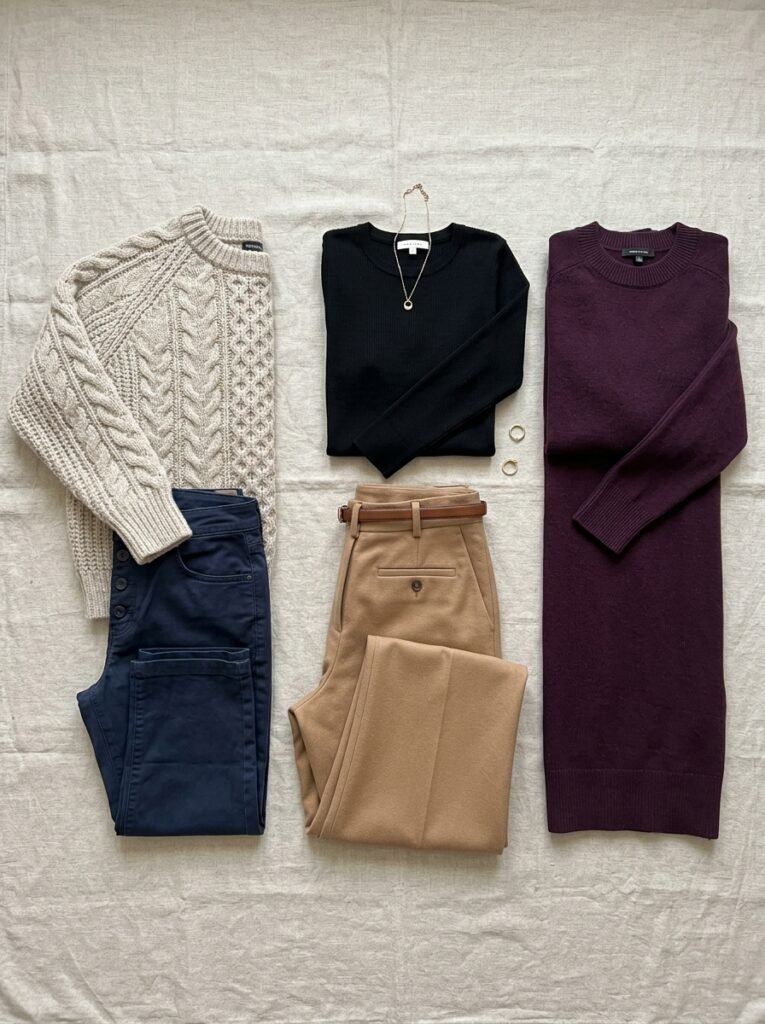
A fine-gauge, long-sleeved knit in a deep neutral — black, charcoal, chocolate or aubergine — with a mock neck rather than a turtleneck.
It is not the exciting answer, but it is the piece that unlocks every trend above. It layers under the Fair Isle without adding thickness. It sits under an open-stitch knit and closes it. It goes under a cardigan, under a coat, under a knit vest, and it works alone with a maxi skirt. Everything else this season is decoration on top of that base.
Second purchase: the Fair Isle sweater, in the quietest colourway you can find rather than the loudest.
Key Takeaways
- Spend your volume once. One big piece per outfit, everything else deliberately narrow.
- Fine-gauge bases are what make chunky layers wearable over a covered silhouette.
- Fair Isle is the season’s easiest win — a yoke pattern needs no waist or hem to work. Match your hijab to the quietest colour in it, not the brightest.
- Long, slouchy knit dresses do modesty work through drape; buy weight, not fineness.
- Knit-on-knit needs texture contrast, not matched weights — and stops at two layers.
- Cutout and mesh knits get layered over an opaque fine-gauge base, or skipped.
- Mock and funnel necks beat turtlenecks with a wrapped scarf every time.
- Match yarn to scarf fabric: fuzzy knits with jersey hijabs, smooth knits with chiffon.
FAQ
What are the main fall 2026 knitwear trends?
Fair Isle and heritage patterns, broad or puffy shoulders and boxy silhouettes, knit-on-knit texture layering, long slouchy sweater dresses, argyle, tapered cardigans, and cutout or mesh knits. The season’s overall direction is precision and craft rather than novelty.
How do you wear an oversized sweater modestly without looking bulky?
Keep the volume in one place. Pair an oversized or big-shouldered knit with a straight or narrow bottom half and a flat, undraped scarf, and layer it over a fine-gauge base rather than a second thick piece. Two volumes stacked read as bulk; one reads as intentional.
Can you wear a turtleneck with a hijab?
It works better with a mock neck or funnel neck. A full turtleneck puts two thicknesses of fabric in the same few inches of neck, which bulks and pushes the scarf forward. A wide crew or boat neck is the other good option, letting the scarf handle the neckline alone.